Single Leg Glute Bridge.
The single leg glute bridge lifts the hips off the floor using one leg, isolating one glute with nothing but bodyweight. It is the simplest single leg glute exercise, needing no equipment, and a staple of warm ups and rehab.

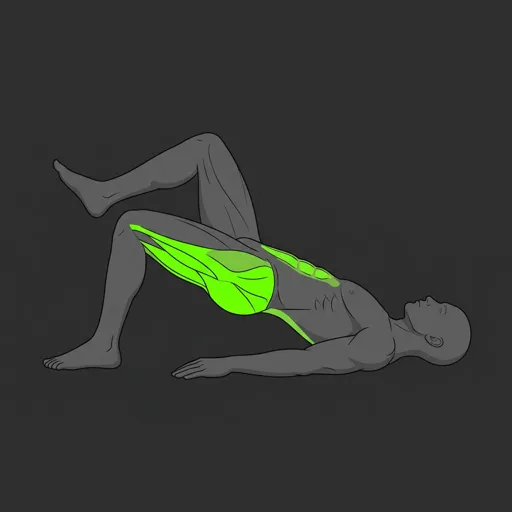
Step by step.
Lie on your back with your feet flat and knees bent.
Raise one leg off the floor by pulling that knee toward your chest. This is the start.
Drive through the heel of your planted foot to lift your hips toward the ceiling.
Extend until your body forms a straight line from shoulders to working knee, squeezing the glute.
Keep your hips level, not letting the raised side sag.
Lower under control and finish all reps before switching legs.
This is the floor version of single leg glute work, no bench, no weight, no setup, which is exactly why it is the place to start. It slots in as a warm up before squats or deadlifts, as a way to wake up glutes that have gone quiet after a day at a desk, and as early rehab where a single leg hip thrust would still be too much. Beginners and seasoned lifters both find a use for it.
Square hips do the job. The raised side wants to dip toward the floor, and when it does, the lower back and trunk quietly take over the lift. Hold the pelvis flat across the whole rep so the planted glute is the one working. If you feel it creep into your hamstring or lower back, you are probably arching up to finish instead of squeezing the glute to lockout.
Where you plant the foot changes the feel. Heel tucked closer to your butt pulls the quad into it. A foot set further out tips the emphasis onto the glute and hamstring. Push through the heel so the glute stays the prime mover, and slide the foot around until you find the spot where the working glute lights up.
Because it is light and recovers fast, it earns a spot as activation, as a finisher, or as the rung you climb before loading. Run 12 to 20 reps per leg, then move on to the loaded single leg hip thrust and the barbell glute bridge once bodyweight stops asking much of you. Few exercises this plain stay useful from your first week of lifting through your last.
Common questions.
A glute bridge is done on the floor with a shorter range, while a hip thrust puts a bench under your upper back for a longer range and easier loading. The single leg glute bridge is the simpler, equipment free option for warm ups and rehab, whereas the hip thrust is the heavier strength builder.
Usually because you are arching to finish or letting the raised hip sag, both of which pull the lower back and hamstrings in. Keep the pelvis level, drive through the planted heel, and squeeze the glute to lockout rather than shoving the hips higher with your spine.
Heel closer to your butt brings the quads in more, while a foot a little further out emphasizes the glutes and hamstrings. Drive through the heel so the glute stays the main mover, and experiment with the distance to find where you feel the working glute most.
One of the best. It needs no equipment, wakes the glutes before squats or deadlifts, and works one side at a time to catch imbalances early. Run 12 to 20 reps per leg as activation or a finisher, then progress to the single leg hip thrust or barbell glute bridge for heavier loading.


Run the numbers.
One-rep max.
Estimate your max from any rep count. Five formulas, full percentage table.
Plate calculator.
What to load for any target weight, in lb or kg.
RPE calculator.
Convert rate of perceived exertion to training percentages.
Wilks score.
Bodyweight-adjusted total for comparing strength across weight classes.
DOTS score.
The IPF's newer bodyweight-adjusted scoring formula.
IPF GL points.
The IPF's official Goodlift score, in use at meets since 2020.
Volume calculator.
Weekly sets per muscle group, tonnage, and load management.
Strength ratio.
Screen your squat, bench, and deadlift to find the lift that is lagging.
Stop calculating.
Start tracking.
Log every set in RepRaptor. Free forever for lifters.