Reverse Hyperextension.
The reverse hyperextension lifts the legs behind you while your torso rests face down on a bench, training the glutes, hamstrings, and lower back. It builds the posterior chain while being gentle on the spine, which is why it doubles as recovery work.

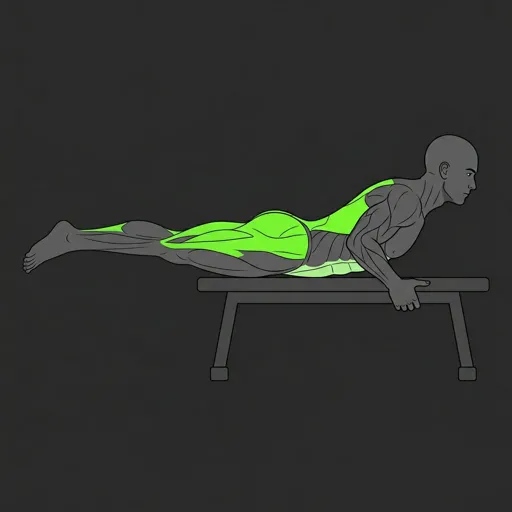
Step by step.
Lie face down on a reverse hyper machine or a high bench with your hips at the edge and legs hanging down.
Grip the handles or the sides of the bench firmly to anchor your upper body. This is the start.
Keeping your legs together and fairly straight, lift them behind you by squeezing the glutes and lower back.
Raise until your legs are in line with your torso or slightly above.
Squeeze the glutes hard at the top, then lower under control.
Avoid swinging your legs up with momentum. Keep it controlled both ways.
The reverse hyper flips a back extension around: your torso is anchored and your legs do the moving, so you train the same posterior chain with almost no compression through the spine. That is the whole appeal. You build glutes, hamstrings, and lower back through hip extension without the axial load of a romanian deadlift or a heavy hinge, which means you can add posterior chain volume your spine can still absorb late in a hard week.
A lot of lifters reach for it to do the opposite of loading. Letting the legs hang and swing gently under control creates a mild traction at the hips and lower back, and plenty of people walk away with their back feeling looser rather than beaten. Louie Simmons built the machine around that idea. Light, it is recovery and rehab. Loaded and controlled, it is real strength work.
The trap is turning it into a pendulum. Fling the legs up with momentum and let them crash back and you trade muscle work for swing, with a jolt to the lower back at the bottom. Lift with the glutes, pause in line with your torso, and lower under control. If the only way to raise the legs is by swinging them, the load is too heavy.
Run 10 to 20 reps as posterior chain accessory work or active recovery, pairing it with a romanian deadlift on heavier days and a barbell glute bridge for direct glute work. On a brutal training week, it is the rare back work your spine will actually thank you for.
Common questions.
The glutes, hamstrings, and lower back through hip extension, the same posterior chain as a back extension, but with your torso anchored and your legs moving. The difference is that it loads those muscles with almost no compression on the spine, so it adds posterior chain volume your back can absorb.
Many lifters find it is. Letting the legs hang and move under control creates a gentle traction at the hips and lower back that can leave the back feeling looser. Light, it works as decompression and recovery. Loaded, it builds strength. The controlled version delivers either, not a wild swing.
Swinging trades the muscle work for momentum and jolts the lower back at the bottom. Lift the legs with your glutes, pause in line with your torso, and lower under control so the posterior chain works both ways. If you can only raise the legs by flinging them, lighten the load.
As posterior chain accessory work or active recovery on lighter days, since it adds glute, hamstring, and lower back volume without compressing the spine. Run 10 to 20 reps, pairing it with a romanian deadlift and a barbell glute bridge for direct glute training.


Run the numbers.
One-rep max.
Estimate your max from any rep count. Five formulas, full percentage table.
Plate calculator.
What to load for any target weight, in lb or kg.
RPE calculator.
Convert rate of perceived exertion to training percentages.
Wilks score.
Bodyweight-adjusted total for comparing strength across weight classes.
DOTS score.
The IPF's newer bodyweight-adjusted scoring formula.
IPF GL points.
The IPF's official Goodlift score, in use at meets since 2020.
Volume calculator.
Weekly sets per muscle group, tonnage, and load management.
Strength ratio.
Screen your squat, bench, and deadlift to find the lift that is lagging.
Stop calculating.
Start tracking.
Log every set in RepRaptor. Free forever for lifters.