Good Morning.
The good morning loads the hamstrings and lower back through a hip hinge with a barbell on your upper traps. The bar stays on the back the whole lift. You hinge forward until the torso is near parallel to the floor and then extend back to standing through hip extension.

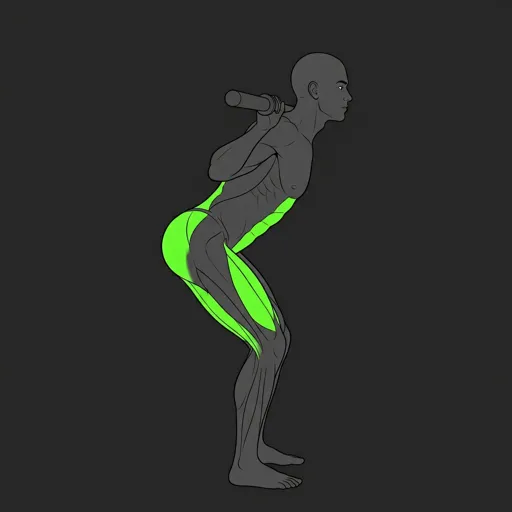
Step by step.
Set the bar low across the rear of your shoulders and upper traps, the same place you would carry a low bar squat, and grip just outside your shoulders.
Stand with your feet about hip width apart, brace your core hard, and unlock your knees so they stay softly bent.
Start by pushing your hips straight back, letting your torso tip forward as a single rigid unit rather than bending at the waist.
Keep your back flat and the knees in that same soft bend as you hinge, feeling the stretch build in your hamstrings.
Stop when your torso reaches roughly parallel to the floor, or sooner if your back starts to round. Going past parallel adds risk without adding much.
Reverse the movement by driving your hips forward and squeezing your glutes to bring your torso back to standing. Start light, around 30-40% of your squat max.
Bar position on this lift is more important than people think. The bar should sit low, on the rear of the deltoids and across the upper traps. Same position as a low-bar squat, not the high-bar position. With the bar high on the neck, the moment arm from the bar to the hips is longer at the bottom of the hinge, which amplifies the force on the lumbar spine. Low bar placement shortens that moment arm and makes the lift substantially safer under load.
Knees stay slightly bent throughout. This is not a stiff-leg version of anything. It's a hip hinge, and slightly bent knees allow the pelvis to tilt forward properly as you hinge. Lock the knees straight and the hamstrings run out of length and either the lumbar spine rounds to compensate or the range of motion cuts short. Neither is what you want.
The hinge should feel like you're pushing your hips backward, not bending your torso forward. Same hip hinge mechanics as a Romanian deadlift, except the load is on your back instead of in your hands. If you've never done an RDL, learn it first and transfer the feeling. The good morning tests the same posterior chain, just from a different angle with a different bar position.
Where this lift earns its place: heavy good mornings build the lower back, glutes, and hamstrings in a way that closely mimics what happens at the bottom of a squat or deadlift. Powerlifters have used them as accessory work for decades specifically because the position of mechanical disadvantage at the bottom of the hinge mirrors the sticking point in a heavy squat. Start light. 30-40% of your squat max is plenty. The loading ceiling is not the goal; the tension on the posterior chain is. Pull that percentage off a real squat number, so estimate it from your one rep max instead of picking a weight that just feels about right.
Common questions.
Any barbell exercise with a loaded spine can cause injury if the technique is wrong, and the good morning is not an exception. The specific risks are lumbar rounding under load at the bottom of the hinge, excessive forward lean past horizontal (which dramatically increases the moment arm), and too much weight for the current strength level. With a neutral spine, low bar position, and appropriate load, the good morning is no more dangerous than a heavy Romanian deadlift or squat. The reputation for danger comes from lifters going too heavy with poor technique, not from the movement pattern itself.
They train the same muscles through the same hip hinge pattern, but the load placement is different. In a Romanian deadlift, you hold the bar in your hands, which limits upper back involvement and puts the load closer to the floor. In a good morning, the bar is on your back, which changes the moment arm, increases the demand on the lumbar erectors and upper back to support the load, and removes the grip constraint. Good mornings tend to be done lighter because the mechanics are less favorable for moving weight, but the loading on the posterior chain at the point of maximum hinge is comparable.
Until your torso is roughly parallel to the floor, not past it. Going past parallel doesn't add meaningful training stimulus; it just increases the moment arm on the lumbar spine and the risk of losing a neutral spinal position. If you can't maintain a flat or slightly arched back near horizontal, your range of motion is already past your current capacity. Stop where form holds, which for most people is 30 to 45 degrees short of parallel when they first attempt this lift.
Typical recommendations in powerlifting programs put the good morning at around 30-50% of your back squat max. If you're squatting 300 lbs, a 90-150 lb good morning for controlled sets of 5-8 is appropriate. The lift isn't meant to be loaded like a primary compound movement. Lifters sometimes push these heavier as a competition exercise, but for accessory and posterior chain work, the lower end of that range is where most of the value is.


Run the numbers.
One-rep max.
Estimate your max from any rep count. Five formulas, full percentage table.
Plate calculator.
What to load for any target weight, in lb or kg.
RPE calculator.
Convert rate of perceived exertion to training percentages.
Wilks score.
Bodyweight-adjusted total for comparing strength across weight classes.
DOTS score.
The IPF's newer bodyweight-adjusted scoring formula.
IPF GL points.
The IPF's official Goodlift score, in use at meets since 2020.
Volume calculator.
Weekly sets per muscle group, tonnage, and load management.
Strength ratio.
Screen your squat, bench, and deadlift to find the lift that is lagging.
Stop calculating.
Start tracking.
Log every set in RepRaptor. Free forever for lifters.