Sumo Deadlift.
The sumo deadlift uses a wide stance with the feet near the collar sleeves and hands gripping inside the legs. The wider stance shortens the bar's range of travel, shifts more demand onto the hips and adductors, and often suits lifters with longer femurs better than conventional.

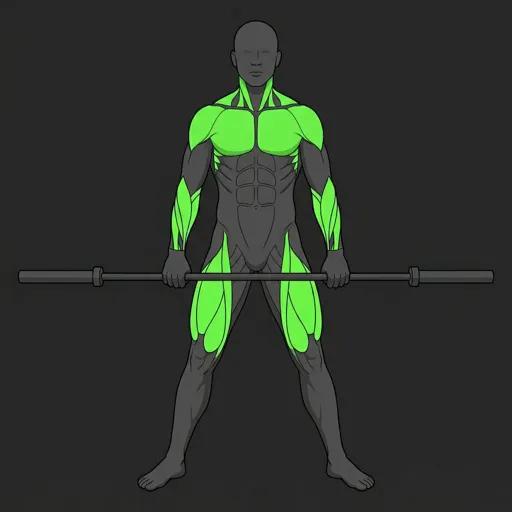
Step by step.
Set a wide stance with your feet close to the collar sleeves and your toes turned out about 30 to 45 degrees, the bar over your midfoot.
Drop your hips and grip the bar with both hands inside your knees, roughly shoulder width or a little closer for very wide stances.
Lower your hips, lift your chest, and let your arms hang straight down from your shoulders to the bar.
Pull your shoulder blades down into your back pockets to build lat tension before the bar leaves the floor.
Push your feet out as if spreading the floor apart, then drive your legs down so the bar and your hips rise together until the bar clears your knees.
Stand tall and lock out by squeezing your glutes, then lower the bar under control along the same path back to the floor.
Stance width is individual, and the right sumo stance is wider than most beginners guess. The feet should be close to the collars, not just slightly wider than shoulder-width, but approaching the ends of the bar. Toes point out, typically 30 to 45 degrees depending on hip structure. Before committing to a width, squat down and let your hips settle to their natural position. If the hips feel blocked and the knees track badly, the stance is too wide or the toes need to turn out more. If the knees are flaring past the hands, it's not wide enough.
The setup requires the hips to be much lower than in conventional because the stance shortens the effective "leg" of the movement and the hips need to be inside the legs at the start. Hips low, chest up, arms straight down from the shoulders to the bar, inside the knees, not outside. This puts the arms in a narrower grip than conventional, usually shoulder-width or even closer for very wide stances.
The pull initiates differently than conventional. Think of it as spreading the floor apart with your feet rather than pushing the floor down. That external rotation cue activates the adductors and hip abductors to stabilize the wide stance and creates the torque needed to pull the hips through at lockout. Without it, the hips rise before the bar clears the floor and you end up in a stiff-leg position.
One common sumo-specific fault: the chest dropping and the hips rising before the bar breaks the floor. This happens when the lats aren't braced. Cue: pull your shoulder blades into your back pockets and create lat tension before the pull starts. The hips and shoulders should rise at the same rate until the bar clears the knee.
If the wide stance keeps fighting your hips no matter how you set up, your proportions may favor the conventional deadlift instead. Neither stance is more correct. Pull the one that lets you move real weight with a flat back.
Common questions.
No. It's a different lift with different demands. Sumo's shorter range of motion is offset by the difficulty of the wide stance, the hip mobility it requires, and the adductor and hip abductor demands that conventional doesn't tax the same way. Pulling with a very wide sumo stance requires significant hip mobility that most people simply don't have. In powerlifting, both stances are legal because the governing bodies determined neither has a categorical advantage. The data bears that out at the elite level, where top pullers exist in both camps.
Lifters with relatively long femurs and shorter torsos often pull sumo more comfortably because the wide stance compensates for the leverage disadvantage those proportions create in conventional. Lifters with longer torsos and shorter legs often find conventional more natural. Hip structure matters too. Some hip sockets allow more external rotation, making wide stances easier. The practical test is to try both after learning the basics. Pull conventional for a few months, pull sumo for a few months, and note which lets you move more weight with better technique. That's your starting point.
Sumo requires hip mobility and adductor strength that most people haven't specifically developed. If you've been pulling conventional for years and switch to sumo, the hip rotation demands and the wide stance feel foreign initially. Expect a significant drop in numbers for the first 4-8 weeks. Adductor work (Copenhagen planks, sumo goblet squats, wide-stance leg press) accelerates the transition. Hip mobility drills (specifically internal and external hip rotation work) are often the real bottleneck for lifters who can't get into a proper sumo setup.
Match your working stance for warm-ups. Switching stance mid-session dilutes the neural patterning you're building. Warm-up sets should groove the same mechanics you'll use when it gets heavy. Some lifters do a few light conventional reps as a general warm-up before sumo-specific warm-ups, which is fine. But your working sets and the sets immediately before them should all use the same technique.


Run the numbers.
One-rep max.
Estimate your max from any rep count. Five formulas, full percentage table.
Plate calculator.
What to load for any target weight, in lb or kg.
RPE calculator.
Convert rate of perceived exertion to training percentages.
Wilks score.
Bodyweight-adjusted total for comparing strength across weight classes.
DOTS score.
The IPF's newer bodyweight-adjusted scoring formula.
IPF GL points.
The IPF's official Goodlift score, in use at meets since 2020.
Volume calculator.
Weekly sets per muscle group, tonnage, and load management.
Strength ratio.
Screen your squat, bench, and deadlift to find the lift that is lagging.
Stop calculating.
Start tracking.
Log every set in RepRaptor. Free forever for lifters.