Board Press.
The board press is a bench press done to a board on the chest, cutting the range short so you train the top half of the lift. It overloads the lockout and the triceps with weight heavier than a full range bench allows.

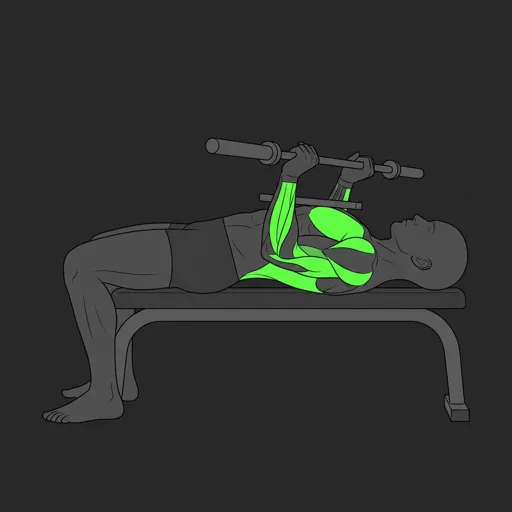
Step by step.
Have a partner hold a board, or a stack of them, on your chest, or secure it under your shirt. One to four boards sets the height.
Set up like a normal bench: shoulder blades pinned, feet driving, a tight arch. Pull the bar out of the rack.
Lower the bar under control until it touches the board, keeping the elbows in line with the wrists.
Pause briefly on the board without sinking into it or bouncing.
Drive the bar up off the board with maximum force to lockout, keeping the elbows tucked.
Rack the bar with your partner once the set is done.
The board sits on your chest and cuts the press short, parking you in the top half of the bench where the triceps do most of the work. Because you skip the hardest stretched portion off the chest, you can handle more weight than a full range barbell bench press allows. Powerlifters reach for it precisely for that overload, to drive the lockout and get the body used to heavier loads.
It trains the sticking point head on. Most missed bench presses stall a few inches off the chest, and the board lets you load and hammer exactly the range above that, building the triceps strength that finishes a heavy press. In that sense it is a heavier barbell cousin of triceps work like the close grip bench press and the skullcrusher, only with loads that dwarf either.
Pause, do not bounce. The board tempts you to sink the bar in and rebound, which fakes strength you do not have and can bruise the chest. Touch it, hold the bar dead for a beat, then drive. You are training force from a dead stop in the top range, and a bounce throws that away.
Lower stacks of one or two boards stay close to a full press; higher stacks bias the triceps and lockout harder. It is strength work first, so run it heavy for 3 to 6 reps as bench accessory, with a spotter any time the load gets serious. Set the weight off your one rep max so the overload is a deliberate choice.
Common questions.
The board stops the bar a few inches off the chest, cutting out the hardest part of the press and letting you overload the top half. That builds lockout strength and the triceps, and trains the body to handle weights heavier than a full range bench allows. Powerlifters use it specifically to push past their bench sticking point.
It depends on what you are training. One or two boards keep the press close to a full range and work most of the movement, while three or four boards shorten it further to bias the triceps and the lockout. Pick the height that matches your sticking point or the range you want to overload, and stay consistent within a block.
No. Bouncing fakes strength and can bruise your chest. Touch the board, pause the bar dead for a beat, then drive up with maximum force. The whole value of the board press is building power from a full stop in the top range, and bouncing off the board removes exactly that benefit.
Mainly strength. The shortened range and heavy load make it a lockout and triceps overload tool rather than a hypertrophy movement, so run it heavy for 3 to 6 reps as bench accessory work. For triceps size, lighter full range work like the close grip bench press or skullcrushers is the better fit. Always use a spotter when loading heavy.


Run the numbers.
One-rep max.
Estimate your max from any rep count. Five formulas, full percentage table.
Plate calculator.
What to load for any target weight, in lb or kg.
RPE calculator.
Convert rate of perceived exertion to training percentages.
Wilks score.
Bodyweight-adjusted total for comparing strength across weight classes.
DOTS score.
The IPF's newer bodyweight-adjusted scoring formula.
IPF GL points.
The IPF's official Goodlift score, in use at meets since 2020.
Volume calculator.
Weekly sets per muscle group, tonnage, and load management.
Strength ratio.
Screen your squat, bench, and deadlift to find the lift that is lagging.
Stop calculating.
Start tracking.
Log every set in RepRaptor. Free forever for lifters.