Triceps Dips.
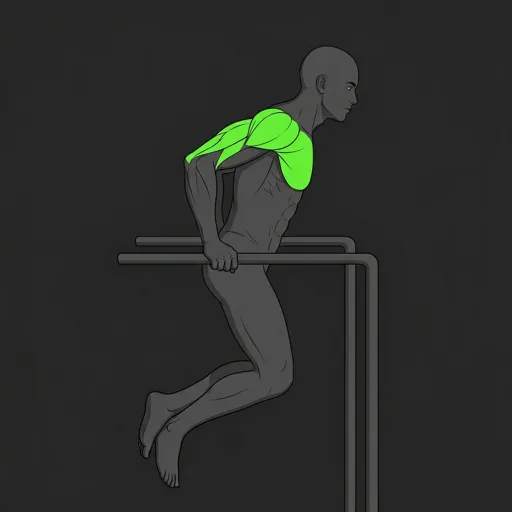
Triceps dips are performed on parallel bars with the torso kept upright throughout. Arms lower the body until the elbow reaches 90 degrees, then press back to lockout. The upright torso position keeps the chest out of the movement and focuses the load on the triceps.

Step by step.
Grip a set of parallel bars and press up to support yourself with the arms locked out, the torso vertical, and the chest up. Look straight ahead, not down.
Hold the torso upright through the whole rep. Leaning forward shifts the load onto the chest, so keep the chest tall and the shoulders down away from the ears.
Bend the elbows to lower yourself, letting them point back toward your heels rather than flaring out to the sides. The upper arms stay close to the body as you descend.
Stop when the elbows reach about 90 degrees. Going deeper than that stretches the front of the shoulder under load and adds little for the triceps.
Press through the heels of your hands and straighten the arms to drive back up to a full lockout, keeping the torso vertical the entire way.
Squeeze the triceps hard at the top, then lower under control into the next rep. If you feel pain at the front of the shoulder, shorten the depth.
The distinction between a chest dip and a triceps dip is torso angle. Lean forward and the chest takes over. That's a chest dip. Stay upright with the torso vertical and the chest out, and the triceps do the bulk of the work on the way back up. Most commercial gyms have dip stations that push you toward a slight forward lean because of bar spacing. If you're leaning forward more than a few degrees and feeling it mainly in your chest, your goal should be to find bars spaced narrower and practice keeping the elbows close to the torso throughout.
Elbow path matters. Elbows flaring wide at the bottom, like a push-up with hands too wide, loads the shoulder capsule in a position it wasn't designed to handle under load. Elbows should track back, not out. At the bottom of a triceps dip, the upper arm should be close to the body and pointing roughly backward, not sideways. If you're feeling anterior shoulder pain during dips, elbow flare is usually the cause before any other diagnosis.
Depth: the standard is a 90-degree angle at the elbow. Going deeper increases the shoulder stretch, which can be fine for mobility but also increases stress on the pec minor tendon and anterior capsule. Ninety degrees is deep enough to get a full triceps contraction on the press and is the safest general-purpose target. Some lifters feel a painful shoulder stretch past 90. That's the signal to stop there.
Adding weight changes the stimulus significantly. Bodyweight dips at 20+ reps are a muscular endurance exercise. A dipping belt with 45 lb for sets of 5 is a strength exercise. Both are useful; don't neglect the weighted variation once bodyweight reps get easy. For variations, parallel bar dips are the loadable standard, bench dips scale down for beginners, and ring dips add an instability challenge once both feel easy.
Common questions.
Torso angle. Triceps dips keep the torso upright and vertical throughout the movement; the elbows track close to the body and the press at the top is driven by the triceps. Chest dips involve leaning the torso forward, which shifts the angle so the pectorals handle more of the load on the way up. Both are legitimate exercises. The version described here is the triceps version, which is why keeping the torso vertical is emphasized so heavily. If you're leaning forward significantly and the chest is doing the main work, you're doing a chest dip.
Three common causes. First: going too deep, past 90 degrees, which overstretches the anterior shoulder capsule and pec minor tendon. Stop at 90 degrees. Second: elbows flaring out to the sides rather than tracking back close to the torso, which puts the shoulder in a compromised position under load. Keep the elbows pointing backward, not outward. Third: performing dips when the shoulder is already irritated. Dips place the shoulder in an extreme stretched position under load and are not a good exercise to push through pain. If technique is clean and pain persists, substitute close-grip bench press or overhead triceps extensions while the shoulder recovers.
Assisted dips using a resistance band looped over the bars are the standard starting point. The band provides upward force at the bottom where the movement is hardest. Alternatively, use a dip machine with a counterweight. The most effective progression for raw strength, though, is slow eccentrics: step or jump to the top position (arms locked) and take 5-8 seconds to lower yourself to the bottom. Three sets of three to five slow negatives will build the pushing strength faster than assisted reps for most people. Add one second to the eccentric each week, or reduce assistance.
Rough benchmarks: 10 clean bodyweight reps with a vertical torso is a solid intermediate standard for most men; 5-8 for women, given the lower ratio of upper body strength to bodyweight. Getting to 15+ strict reps typically means it's time to add weight to keep the strength adaptation going. For context: a lifter who can do 10 strict dips with 45 lb of additional weight has pressing strength that transfers well to close-grip bench press at similar loads.


Run the numbers.
One-rep max.
Estimate your max from any rep count. Five formulas, full percentage table.
Plate calculator.
What to load for any target weight, in lb or kg.
RPE calculator.
Convert rate of perceived exertion to training percentages.
Wilks score.
Bodyweight-adjusted total for comparing strength across weight classes.
DOTS score.
The IPF's newer bodyweight-adjusted scoring formula.
IPF GL points.
The IPF's official Goodlift score, in use at meets since 2020.
Volume calculator.
Weekly sets per muscle group, tonnage, and load management.
Strength ratio.
Screen your squat, bench, and deadlift to find the lift that is lagging.
Stop calculating.
Start tracking.
Log every set in RepRaptor. Free forever for lifters.