Ring Dips.
Ring dips are dips done on gymnastic rings, where the hands are free to move in every direction. The instability turns a straightforward push into a full body control challenge, demanding far more stability than fixed bars.

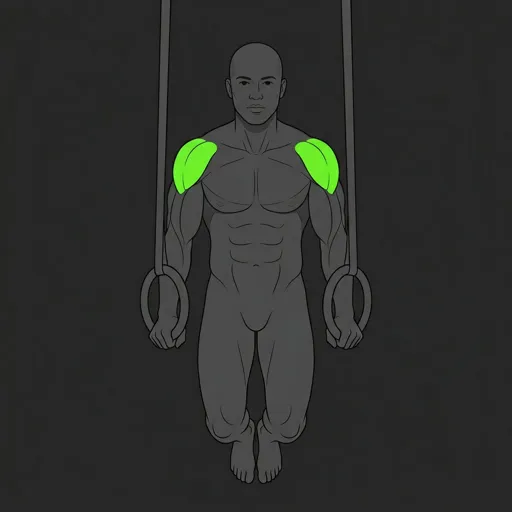
Step by step.
Set the rings at a height where your feet clear the floor. Jump or press up to support yourself with arms locked out and palms turned in.
Stabilize the rings against your sides and find a still, balanced top position. This is the start.
Lower under control by bending the elbows, fighting the rings drifting apart the whole way.
Descend until your arms break 90 degrees, keeping the rings close to your body.
Press back up to lockout, then turn the rings out at the top for the hardest finish.
Keep your body tight and avoid swinging or kipping to move up.
Rings expose how much fixed bars do for you. On parallel bars the path is set, but rings hang free from a single anchor, so they want to swing, rotate, and pull apart, and your shoulders, chest, and triceps have to fight all of it just to keep the rep honest. So ring dips punish you far more than the same count of triceps dips on bars, and they build a control and stabilizer strength fixed dips never touch. If bar dips have gone easy, here is the next mountain.
Earn them in order. Plenty of strong lifters can rep bar dips and still flail on rings, because stability is its own skill. Get a strict ring support hold at the top first, then partial range dips, then full depth. Skip straight to deep ring dips and the unstable bottom, the most vulnerable spot, is how shoulders get tweaked.
The turnout is the signature finish, and it is optional. Rotating the rings so the palms face forward at the top piles on a brutal stability and chest demand, but a neutral, palms in finish is still a complete rep. Add the turnout once your strict ring dips are clean.
Run fewer reps than you would on bars, since the stability tax is high, and end the set when your control goes, not when the triceps finally quit. A handful of steady ring dips beats a longer set of wobbly ones.
Common questions.
Rings hang from a single point up top, so they sway and twist and try to drift apart while you press your own bodyweight. Your shoulders and chest and triceps end up stabilizing all that motion, work that fixed bars handle for you. That extra control demand is what makes ring dips far harder than the same number of triceps dips on parallel bars.
Build the stability in stages. Start with a strict ring support hold at the top until you can hold it dead still, then add partial range dips, then work to full depth. The unstable bottom is the most vulnerable position, so jumping straight to deep ring dips before you own the support hold is a common way to tweak a shoulder.
Rotating the rings so your palms face forward at lockout, which adds a big stability and chest challenge to the finish. It is the signature of a polished ring dip but it is optional. A neutral, palms in finish is still a full rep. Add the turnout only once your strict ring dips are clean and controlled.
No, expect far fewer, because the stability cost is so high. End the set when your control breaks and the rings start to swing, well before your triceps would fail on a fixed bar.


Run the numbers.
One-rep max.
Estimate your max from any rep count. Five formulas, full percentage table.
Plate calculator.
What to load for any target weight, in lb or kg.
RPE calculator.
Convert rate of perceived exertion to training percentages.
Wilks score.
Bodyweight-adjusted total for comparing strength across weight classes.
DOTS score.
The IPF's newer bodyweight-adjusted scoring formula.
IPF GL points.
The IPF's official Goodlift score, in use at meets since 2020.
Volume calculator.
Weekly sets per muscle group, tonnage, and load management.
Strength ratio.
Screen your squat, bench, and deadlift to find the lift that is lagging.
Stop calculating.
Start tracking.
Log every set in RepRaptor. Free forever for lifters.