Triceps Pushdown.
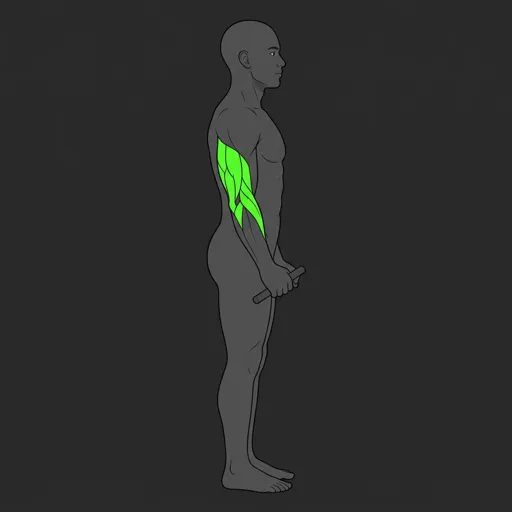
The triceps pushdown uses a high cable pulley to train the triceps through elbow extension. The upper arms stay pinned to the sides while the forearms push the bar or rope from a high start position to full extension, with only the forearms moving.

Step by step.
Set the pulley near the top of the cable tower and attach a rope or straight bar. Grab the attachment, step back slightly, and stand tall with a soft knee bend and a small forward lean for balance.
Pin your upper arms against your sides so they sit perpendicular to the floor. Bring the bar up until your forearms are roughly parallel to the ground, with your elbows bent and locked in place.
Push the attachment down by extending your elbows, moving only your forearms. Keep your upper arms stationary against your torso and your wrists firm throughout.
Drive all the way to full lockout at the bottom and squeeze the triceps hard, fanning the rope apart slightly if you are using one. This is where the medial head works hardest.
Let the forearms come back up under control to the start, keeping your elbows pinned the whole time. Stop the set if your elbows start creeping forward to finish reps, since the weight is then too heavy.
The upper arm position is the entire exercise. Both upper arms stay perpendicular to the floor, locked against the sides of the torso, for every rep. The moment the elbows drift forward and down to help initiate the movement, the anterior deltoid and lat start taking load off the triceps. You've turned an isolation exercise into a partial lat pulldown. This happens almost exclusively because the weight is too heavy.
There's a specific failure pattern worth calling out: the elbows start pinned, the first 3-4 reps look good, then as fatigue sets in the elbows creep forward 2-3 inches so the lifter can complete the set. This is the point where you should have stopped. The reps where the elbows drifted aren't tricep reps. They're ego reps. If you can't complete the set with the upper arms stationary, the weight came off the stack too soon.
Full lockout at the bottom matters. The medial head of the triceps is the primary elbow extensor and it's most active in the final 20 degrees of extension. Stopping short at the bottom (bar at hip height instead of touching the thighs) means you're skipping the most productive part of the range. Push to full arm extension, feel the triceps contract hard, then let the forearms come back up under control.
Rope attachment versus straight bar: the rope allows the wrists to rotate into a neutral or semi-pronated position during the downward phase and then fan out slightly at the bottom, which gives a slightly stronger contraction at lockout. The straight bar keeps the wrists in fixed pronation. Both work. If straight-bar pushdowns cause wrist discomfort, try the rope or a V-bar before concluding you have a joint issue.
Common questions.
Both are effective. The rope lets you rotate the wrists to neutral during the push and separate the hands slightly at the bottom, which some lifters feel gives a stronger tricep contraction at lockout. The straight bar is simpler and lets you handle more weight. If straight-bar pushdowns irritate the wrists because of the fixed pronated grip, the rope or a V-bar resolves that for most people. Pick based on what feels best at the joint, not which one looks more serious.
Heavy enough to make the last 2-3 reps of each set difficult, light enough to keep the upper arms completely stationary. For most people the cable stack weight ends up somewhere between 30-60% of the maximum stack, depending on the machine's resistance calibration. If your elbows are drifting forward before you hit rep 8 of a 10-rep set, the weight needs to come down. The triceps pushdown is a detail exercise. Its value is accumulated volume with honest form, not maximum load.
The elbows are probably too far forward at the start, which means the lat is doing the initial work of pulling the elbows down before the tricep even takes over. Pull the elbows back so they're directly under the shoulder joint and pinned against the torso, with forearms pointing toward the pulley. From that position, the only muscle that can extend the forearm is the triceps. If the elbows are in front of the body, the lats and anterior delts are already loaded before the push begins.
A slight forward lean is acceptable and natural. The instructions describe a very small inclination forward, which helps the upper arms stay perpendicular to the floor without cramping against the torso. What's not acceptable is a pronounced forward bend at the waist (like 30-45 degrees) to turn the movement into a partial lat pulldown. The torso should be nearly upright, with just enough lean to feel stable at the stack.


Run the numbers.
One-rep max.
Estimate your max from any rep count. Five formulas, full percentage table.
Plate calculator.
What to load for any target weight, in lb or kg.
RPE calculator.
Convert rate of perceived exertion to training percentages.
Wilks score.
Bodyweight-adjusted total for comparing strength across weight classes.
DOTS score.
The IPF's newer bodyweight-adjusted scoring formula.
IPF GL points.
The IPF's official Goodlift score, in use at meets since 2020.
Volume calculator.
Weekly sets per muscle group, tonnage, and load management.
Strength ratio.
Screen your squat, bench, and deadlift to find the lift that is lagging.
Stop calculating.
Start tracking.
Log every set in RepRaptor. Free forever for lifters.