Tate Press.
The tate press is a dumbbell triceps movement where the weights lower in toward the upper chest with the elbows flared out. It drives the lockout hard and is often felt in the inner triceps, a favorite of bench specialists for building pressing strength.

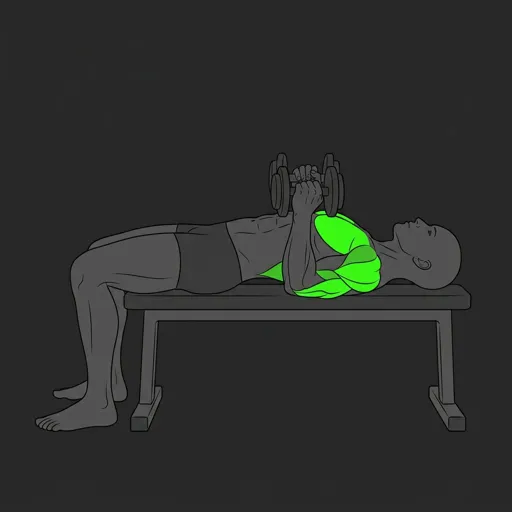
Step by step.
Lie on a flat bench and press two dumbbells up over your chest, palms facing forward, held a little wider than shoulder width.
Point your elbows out to the sides. This is the start.
Keeping the upper arms still, lower the dumbbells down and in toward your upper chest in a semicircle.
Let the dumbbells nearly touch your chest as the elbows bend, without resting them down.
Press back up along the same arc using the triceps, squeezing at the top.
Keep the upper arms stationary throughout. Only the forearms move.
The tate press looks odd and trains one thing well, the triceps lockout. The dumbbells travel in toward the chest as the elbows flare, forcing the triceps to work hard right at the top of the range, the part that finishes a heavy bench. Louie Simmons and the Westside crew popularized it for that reason, as triceps work that carries straight to the close grip bench press and the regular bench rather than just pumping the arms.
It earns its keep where a skullcrusher gets dicey. A skullcrusher loads the triceps in the stretched position behind the head, which can nag some lifters at the elbow, while the tate press keeps the work in the contracted, locked out range and tends to be easier on the joint. If skullcrushers bother your elbows, the tate press hits a similar muscle through a friendlier path.
The movement is awkward and demands frozen upper arms. The whole exercise is the forearms rotating the dumbbells in and out while the upper arms stay put. Let them drift or start pressing and it turns into a clumsy dumbbell press with the triceps emphasis gone. Go light until the path feels natural, because heavy dumbbells in this odd position get away from you fast.
Keep it to higher reps, 10 to 15, with light to moderate dumbbells and a strict path. If your elbows are done with skullcrushers, this is the accessory to slot in their place.
Common questions.
It drives the triceps in the locked out, contracted range, and many lifters feel it most in the inner head. Because the dumbbells move in toward the chest as the elbows flare, the triceps fire hardest at the top of the range, which is the part that finishes a heavy press. It is built to improve bench lockout strength.
Often, yes. A skullcrusher loads the triceps in a stretched position behind the head that can irritate some elbows, while the tate press keeps the work in the contracted lockout range. If skullcrushers bother your elbows, the tate press is a good substitute that trains a similar muscle through a more joint friendly path.
Because the upper arms must stay frozen while only the forearms rotate the dumbbells in and out, which is an unusual pattern. If the upper arms drift or you start pressing, it turns into a sloppy dumbbell press and loses the triceps focus. Go light until the path feels natural, since heavy dumbbells in this position are hard to control.
After your heavy pressing, as lockout focused accessory volume. Use light to moderate dumbbells, keep the upper arms still, and squeeze at the top instead of reaching for weight that wrecks the path.


Run the numbers.
One-rep max.
Estimate your max from any rep count. Five formulas, full percentage table.
Plate calculator.
What to load for any target weight, in lb or kg.
RPE calculator.
Convert rate of perceived exertion to training percentages.
Wilks score.
Bodyweight-adjusted total for comparing strength across weight classes.
DOTS score.
The IPF's newer bodyweight-adjusted scoring formula.
IPF GL points.
The IPF's official Goodlift score, in use at meets since 2020.
Volume calculator.
Weekly sets per muscle group, tonnage, and load management.
Strength ratio.
Screen your squat, bench, and deadlift to find the lift that is lagging.
Stop calculating.
Start tracking.
Log every set in RepRaptor. Free forever for lifters.