Bench Dips.
Bench dips work the triceps with your hands behind you on a bench and your body lowering in front of it. They are the most accessible dip variation, needing only a bench, but the shoulder position asks for some care.

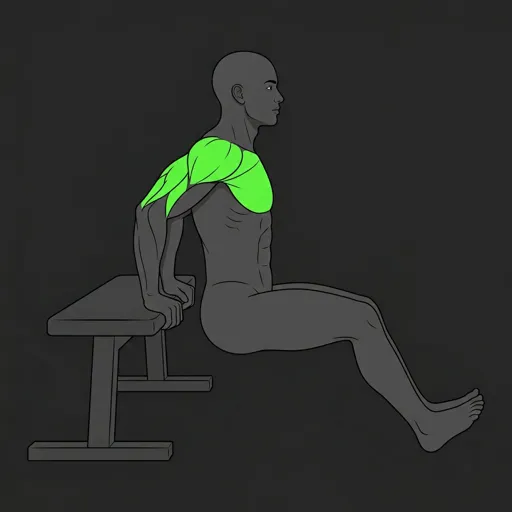
Step by step.
Sit on the edge of a bench and grip the edge at your sides, hands about shoulder width.
Slide your hips off the bench and extend your legs out in front, heels on the floor. This is the start.
Lower your body by bending the elbows until they reach roughly 90 degrees.
Keep your back close to the bench and your elbows pointing straight back, not flaring out.
Press through the triceps to push yourself back up to locked out arms.
Stop the descent if you feel strain in the front of the shoulder rather than the triceps.
Bench dips are the entry point to triceps dips, the one version anybody can do with just a bench, which is why they turn up all over home and bodyweight programs. They load the triceps through a long range, and you can scale the difficulty up or down with nothing more than your foot position.
The catch is the shoulder, and it is worth taking seriously. Because your hands are fixed behind your body, dropping too deep cranks the shoulder into a stretched, internally rotated spot that some people tolerate and others feel as a pinch in the front of the joint. Stop around 90 degrees of elbow bend rather than chasing depth. If your shoulders complain at all, move to a dip on parallel bars, where the joint sits in a friendlier line.
Keep the elbows tracking back. Past going too deep, the biggest fault is letting them flare out to the sides, which shifts work off the triceps and stresses the shoulder more. Drive the elbows straight back behind you so the triceps stay in charge and the joint stays stacked.
Use them for higher reps, anywhere from 10 to 20, as triceps volume or a finisher. Once bodyweight gets easy, set a plate on your thighs to add load. Just do not buy extra reps by sinking deeper into a cranky shoulder.
Common questions.
They can be if you go too deep. With your hands fixed behind your body, a deep descent forces the shoulder into a stretched, internally rotated position that some lifters feel as a pinch. Stopping at about 90 degrees of elbow bend usually keeps them safe. If your shoulders still complain, switch to parallel bar dips, which sit in a friendlier line.
Change your foot position. Knees bent with heels close in is the easiest, legs straight out in front is harder, and propping your feet on a second bench is harder again. You can scale bench dips a long way without any extra equipment.
Straight back behind you, not flaring out to the sides. Flared elbows take work off the triceps and put more strain on the shoulder. Keeping the elbows tracking back behind your body keeps the triceps as the prime mover and the shoulder in a more stable position throughout the rep.
If your shoulders are healthy and a dip station is right there, train on it. The parallel bars let you add weight cleanly and keep the joint in a better line. Bench dips earn their keep when a bench is all you have, like a hotel gym or a living room, where they still build the triceps with zero gear.


Run the numbers.
One-rep max.
Estimate your max from any rep count. Five formulas, full percentage table.
Plate calculator.
What to load for any target weight, in lb or kg.
RPE calculator.
Convert rate of perceived exertion to training percentages.
Wilks score.
Bodyweight-adjusted total for comparing strength across weight classes.
DOTS score.
The IPF's newer bodyweight-adjusted scoring formula.
IPF GL points.
The IPF's official Goodlift score, in use at meets since 2020.
Volume calculator.
Weekly sets per muscle group, tonnage, and load management.
Strength ratio.
Screen your squat, bench, and deadlift to find the lift that is lagging.
Stop calculating.
Start tracking.
Log every set in RepRaptor. Free forever for lifters.