Parallel Bar Dips.
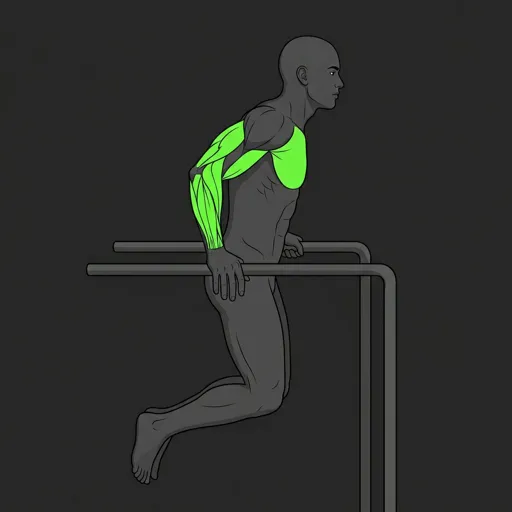
Parallel bar dips lower and press your bodyweight between two fixed bars, working the triceps, chest, and front delts. The torso angle decides whether they hit the triceps or the chest hardest, and they load the upper body heavily through a long range.

Step by step.
Grip a set of parallel bars and press up to support yourself with arms locked out, feet off the floor.
Set your torso angle: upright for triceps focus, leaned forward for chest focus. This is the start.
Lower under control by bending the elbows until your arms break 90 degrees.
Keep the descent steady, with no bouncing at the bottom.
Press back up to full lockout, driving through the triceps and chest.
Stop the descent if you feel a sharp pull in the front of the shoulder.
Dips are the upper body squat. They load a lot of muscle through a long range with nothing but your bodyweight, and parallel bars are the best way to run triceps dips, since the fixed handles let you focus on pushing instead of balancing. Out of the dip family, this is the version to build strength on. You can add real load with a belt once bodyweight gets easy, and the shoulder sits in a far better line than it does on bench dips.
Your torso angle is a dial, so use it on purpose. Stay upright with the elbows tracking back and the work stays on the triceps. Lean your chest forward and let the elbows flare a little and it slides toward the lower chest, much like a decline press. Neither is wrong. Pick the target for the day and hold that position instead of drifting between the two as you tire.
Depth and shoulders are the safety conversation. About 90 degrees of elbow bend is plenty for most people, and sinking well past that into a deep stretch is where shoulders get cranky. Feel a sharp pull in the front of the joint and you shorten the range. Controlled depth beats ego depth every time.
Progress them like a main lift. Train the reps until bodyweight is easy, then strap on a dip belt and work in the 6 to 12 range. Loaded this way, dips build pressing strength that carries straight over to the bench and the close grip bench press.
Common questions.
Both, with your torso angle setting the balance. Staying upright with the elbows tracking back keeps the work on the triceps, while leaning the chest forward and flaring the elbows shifts it to the lower chest. Decide which you want for the session and hold that position. Drifting between the two mid set blurs the target.
To about 90 degrees of elbow bend for most people. That gives a full, productive range while keeping the shoulder in a safe position. Sinking far below parallel stretches the shoulder into a vulnerable spot where many lifters feel pain. If you feel a sharp pull in the front of the shoulder, shorten the range rather than chasing depth.
Add load with a dip belt and chain or a dumbbell between your feet, then train in the 6 to 12 range like any strength lift. Parallel bar dips take added weight well because the bars are stable, which is a big advantage over bench dips. Weighted dips build serious pressing strength.
You can take them as far as a barbell lift. Once bodyweight is easy, hang a dip belt and load the 6 to 12 range, and the parallel bars handle the weight because they are rock solid. Weighted dips put pressing strength on the bench that bench dips never could.


Run the numbers.
One-rep max.
Estimate your max from any rep count. Five formulas, full percentage table.
Plate calculator.
What to load for any target weight, in lb or kg.
RPE calculator.
Convert rate of perceived exertion to training percentages.
Wilks score.
Bodyweight-adjusted total for comparing strength across weight classes.
DOTS score.
The IPF's newer bodyweight-adjusted scoring formula.
IPF GL points.
The IPF's official Goodlift score, in use at meets since 2020.
Volume calculator.
Weekly sets per muscle group, tonnage, and load management.
Strength ratio.
Screen your squat, bench, and deadlift to find the lift that is lagging.
Stop calculating.
Start tracking.
Log every set in RepRaptor. Free forever for lifters.