Oblique Crunch.
The oblique crunch curls the torso up and toward the opposite knee, working the side abs through both flexion and a small twist. It is a simple, equipment free way to train the obliques directly.

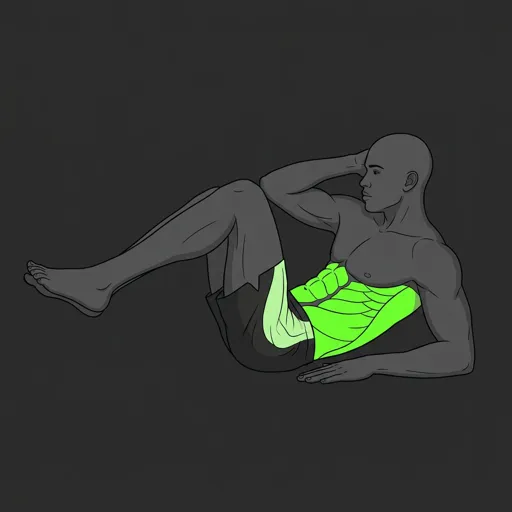
Step by step.
Lie flat on your back with one hand beside your head and the other resting on the floor.
Keep your feet flat or elevated on a surface, knees bent. This is the start.
Curl the shoulder of the hand behind your head up and across toward your opposite knee.
Lift until that elbow travels toward the opposite knee, contracting the side abs.
Lower under control back to the floor.
Finish all reps on one side, then switch hand and side.
The oblique crunch works the side abs mainly through flexion, curling the torso up and in, with a rotational element as your elbow travels toward the opposite knee. So it is not a pure twist and not a pure side bend. It trains the obliques through that combination. A russian twist or a cable woodchop loads rotation against resistance, while this leans on the bending and curling job the obliques also do. Both belong in a rounded midsection plan, so it sits alongside your twisting work, doing a job the twists do only lightly.
You need nothing but the floor to do it, which makes it easy to drop into home sessions, warm ups, or the tail end of any workout. Like a regular crunch, the range is short and the win is in the contraction, not in how far you travel. Do not expect a big movement. Expect the side abs to squeeze.
The neck is where people sabotage it. Reaching the elbow toward the knee, the supporting hand starts dragging the head along for the ride, which strains the neck and robs the abs. Rest that hand against your head with no pull in it and let the obliques do the lifting. Curl up and across in one motion, since that small turn toward the opposite knee is what brings the obliques in.
Fifteen to twenty five reps a side with a squeeze at the top suits it. Progress it by elevating your feet or hugging a light plate to the working side.
Common questions.
The oblique crunch is mostly flexion with a small twist, curling the torso up and toward the opposite knee, while a russian twist and a cable woodchop are built around rotation against load. Both are real oblique jobs, so the moves complement each other. A rounded core plan has some flexion and some rotation.
Twists are mostly rotation, while the oblique crunch adds the flexion and curling side of oblique work that pure twisting leaves lighter. Running both gives the obliques fuller development than rotation alone.
Keep the hand behind your head light and let it rest rather than drag your head toward the knee. Lift with the obliques so your neck stays in line with your spine. A sore neck after a set means your hand did the work. The supporting hand is a guide, not a lever.
Elevate your feet on a bench, slow the tempo, or hold a light plate against the working side. Because the movement is light and joint friendly, you can also add reps or sets. Progress gradually and keep the focus on a hard contraction of the side abs over a bigger range.


Run the numbers.
One-rep max.
Estimate your max from any rep count. Five formulas, full percentage table.
Plate calculator.
What to load for any target weight, in lb or kg.
RPE calculator.
Convert rate of perceived exertion to training percentages.
Wilks score.
Bodyweight-adjusted total for comparing strength across weight classes.
DOTS score.
The IPF's newer bodyweight-adjusted scoring formula.
IPF GL points.
The IPF's official Goodlift score, in use at meets since 2020.
Volume calculator.
Weekly sets per muscle group, tonnage, and load management.
Strength ratio.
Screen your squat, bench, and deadlift to find the lift that is lagging.
Stop calculating.
Start tracking.
Log every set in RepRaptor. Free forever for lifters.