Pistol Squat.
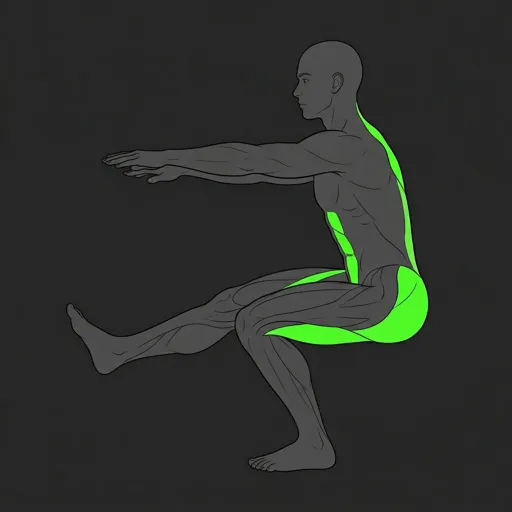
The pistol squat is a full depth single leg squat with the other leg held straight out in front. It demands serious strength, balance, mobility, and control all at once, making it a benchmark of bodyweight lower body ability.

Step by step.
Stand on one leg with the other extended straight out in front of you, arms reaching forward to counterbalance.
Bend the standing knee and sit your hips back and down, keeping the free leg off the floor.
Keep your standing heel planted and descend as deep as possible, ideally hamstring to calf.
Pause briefly at the bottom under control.
Drive through the whole foot to stand back up, keeping the free leg elevated.
Keep the standing knee tracking over the foot and avoid letting it cave inward.
A pistol squat stacks four demands on one leg at once. You need the strength to move your bodyweight, the mobility to reach full depth, the balance to stay upright, and enough ankle range to keep your heel planted. When someone stalls on it, strength is rarely the thing that gave out. Far more often it is ankle mobility or balance, so figure out which piece is limiting you before you grind away, because piling on leg strength will not fix a stiff ankle.
Earn it with progressions. Build single leg strength and control in easier work first, a deep bulgarian split squat for the unilateral load and a goblet squat for the pattern, then practice pistols down to a box and lower the box over time. Holding a light counterweight out front, or gripping a rack with one hand, keeps you balanced while your strength catches up.
Heel down and knee tracking are the technique keys. If your heel lifts at the bottom, that is ankle mobility talking, and parking the heel on a small plate is a fair stopgap while you work the range. The other fault is the standing knee caving in, so drive it out over your foot the whole way through.
Once you own the movement, keep the reps low, 5 to 8 per leg, since the balance and control cost is steep, and add a light dumbbell or kettlebell at the chest when you want to load past bodyweight. On a movement this unforgiving, a few clean reps teach you more than any grindy set.
Common questions.
A pistol needs strength, balance, mobility, and ankle range together, and for most people it is one of the last three that runs out first, usually ankle mobility or balance. Work out which one is holding you back, since adding leg strength does nothing for a stiff ankle or shaky balance.
Build single leg strength with a deep bulgarian split squat and groove the squat pattern with a goblet squat, then practice pistols down to a box and lower it over weeks. A light counterweight held out front or a hand on the rack keeps you balanced while the strength comes.
That is limited ankle mobility. As a stopgap, rest your heel on a small plate so you can stay grounded and still reach depth while you train the range separately. A lifted heel throws your weight backward and cuts the range short, so keeping it down matters.
Hold a light dumbbell or kettlebell at your chest once you own the bodyweight movement. Keep the reps low, around 5 to 8 per leg, since the balance and control cost is high, and chase clean reps with the knee tracking the foot rather than a big number.


Run the numbers.
One-rep max.
Estimate your max from any rep count. Five formulas, full percentage table.
Plate calculator.
What to load for any target weight, in lb or kg.
RPE calculator.
Convert rate of perceived exertion to training percentages.
Wilks score.
Bodyweight-adjusted total for comparing strength across weight classes.
DOTS score.
The IPF's newer bodyweight-adjusted scoring formula.
IPF GL points.
The IPF's official Goodlift score, in use at meets since 2020.
Volume calculator.
Weekly sets per muscle group, tonnage, and load management.
Strength ratio.
Screen your squat, bench, and deadlift to find the lift that is lagging.
Stop calculating.
Start tracking.
Log every set in RepRaptor. Free forever for lifters.