Plate Twist.
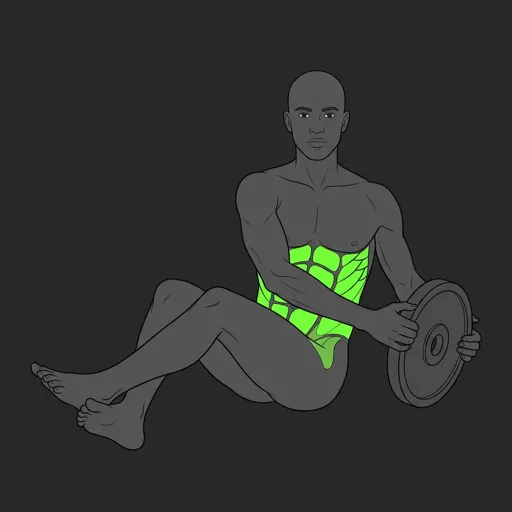
The plate twist is a seated, loaded rotation using a weight plate held in front of the chest, training the obliques to rotate against resistance. A plate is the simplest way to add weight to a twist when no medicine ball is around.

Step by step.
Sit on the floor with your legs extended or knees bent, holding a weight plate by its sides in front of your abs.
Lean your torso back slightly and lift your feet off the floor, crossing your ankles for balance. This is the start.
Rotate your torso to one side and lower the plate toward the floor beside your hip.
Touch the plate down lightly, then rotate to the other side with control.
Keep the movement slow and deliberate. Jerking can strain the back.
Each side to side rotation is one rep.
A plate is the everyman way to load a twist. No medicine ball, no cable station, just a single plate gripped by the sides, which gives you both a handle and a load and turns a bodyweight russian twist into resistance work. Hold the plate out from your body and a lighter one starts to feel heavy, handy when the only plates on the rack jump in big steps.
Lifting the feet is where this gets interesting and where it gets risky. Cross your ankles off the floor and you lose a base of support, which raises the difficulty, but it also tempts you to lean back too far and round the lower back while you sling the plate around. Keep the chest tall and the spine long, turn from the ribcage, and if the back starts to grumble, plant the feet and sit up before carrying on.
Slow rotation matters here more than almost anywhere. A loaded twist on momentum is mostly the plate dragging your arms around while the obliques coast and the lower back picks up the slack. Move with intent, feel the obliques rotate your torso each way, and pause as the plate arrives beside each hip. The weight only earns its keep when the muscle is the thing moving it.
Twelve to twenty reps total works as a baseline, and you progress by going heavier or holding the plate further out. The plate and the medicine ball version do the same job, so grab whichever your gym makes easy, and run it next to a flexion movement to cover the obliques from both directions.
Common questions.
They are interchangeable. A plate gripped by the sides gives you a handle and a load with kit found in any gym, while a medicine ball is purpose built and easier to hold. Use whichever is convenient. Both load the rotation so you can progress the obliques beyond a bodyweight russian twist.
Lifting and crossing your feet raises the difficulty by removing a base of support, but it also tempts you to lean too far back and round the lower back. If you can hold a tall chest and long spine with your feet up, it is a good progression. If your back rounds or aches, plant your feet.
Usually from leaning too far back and rounding the spine while swinging the plate on momentum. Keep the chest tall, rotate from the ribcage, and move slowly with a brief pause at each hip. If it still bothers you, sit more upright, plant the feet, and use a lighter plate.
Go heavier, hold the plate further out to lengthen the lever, or lift and cross your feet to reduce your base of support. Add reps within the 12 to 20 range as a baseline. Keep the rotation slow as you add difficulty, and pair it with an oblique flexion movement for complete coverage.


Run the numbers.
One-rep max.
Estimate your max from any rep count. Five formulas, full percentage table.
Plate calculator.
What to load for any target weight, in lb or kg.
RPE calculator.
Convert rate of perceived exertion to training percentages.
Wilks score.
Bodyweight-adjusted total for comparing strength across weight classes.
DOTS score.
The IPF's newer bodyweight-adjusted scoring formula.
IPF GL points.
The IPF's official Goodlift score, in use at meets since 2020.
Volume calculator.
Weekly sets per muscle group, tonnage, and load management.
Strength ratio.
Screen your squat, bench, and deadlift to find the lift that is lagging.
Stop calculating.
Start tracking.
Log every set in RepRaptor. Free forever for lifters.