Decline Barbell Bench Press.
The decline barbell bench press tilts the bench head down so the bar travels to the lower chest along a shorter path. It loads the lower pec fibers and usually lets you move more weight than a flat press.

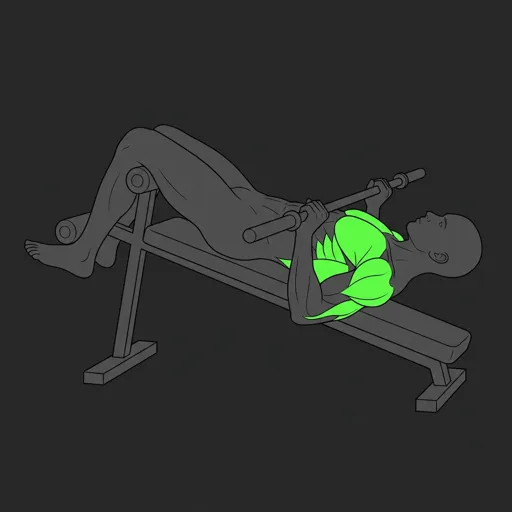
Step by step.
Set a decline bench and hook your legs under the pads so you stay anchored when the bar gets heavy.
Take a grip a touch wider than your shoulders. Have a spotter help you lift off, since reaching back for the bar on a decline is awkward and risky alone.
Bring the bar down under control to your lower chest, just below the nipple line. The forearms should stay vertical.
Touch lightly, no bouncing, then drive the bar back up and slightly toward your face to lock out over the shoulders.
Squeeze the chest hard at the top for a beat, then lower again, taking about twice as long down as up.
Rack the bar carefully with the spotter once the set is done.
The decline gets written off as a gimmick, and that is a mistake. The shorter range and the better leverage at this angle mean most people press more here than on the flat barbell bench press, which makes it a real tool for overloading the chest when the flat press stalls. It will not isolate the lower pec on its own, though it leans into that region harder than the flat bar.
The better reason to keep it around is your shoulders. Pressing on a decline runs the upper arms through a friendlier path than flat or incline work, so lifters whose shoulders bark every flat session can often press here pain free. If the flat bar is chewing up your front delt, rotate to the decline for a block and watch what happens.
Setup is where this lift bites. Hauling a loaded bar off the hooks while lying head down is clumsy, and at the bottom the bar wants to drift toward your throat. Use a spotter every single time you go heavy. The lifter who plays garage hero here is the one who ends up pinned.
Give it a real slot as a main pressing movement. Three to four sets of 5 to 8 build genuine lower chest thickness. Want a triceps bias instead? Narrow the grip toward a close grip bench press width and let the elbows tuck.
Common questions.
Yes. The leverage lets most lifters move more weight than on a flat bench, which is useful for overloading the chest, and the angle is often kinder to the shoulders. It biases the lower chest, though nothing fully isolates one region. If your flat press has stalled or hurts, the decline is a smart rotation.
It leans on the lower pec fibers more than a flat or incline press, so it earns a place when the lower chest lags. On its own it will not sculpt the area. Pair it with flat and incline pressing for a complete chest.
The range is shorter and the angle hands the chest better leverage, so the bar covers less distance through a stronger position. That is also why it works as an overload tool. Read the bigger number as mechanics, not raw strength.
For anything heavy, yes. Lifting off and racking head down is awkward, and a stalled rep parks the bar over your neck with your head below your chest. A spotter handles the lift off and the rerack and makes the whole thing safe.


Run the numbers.
One-rep max.
Estimate your max from any rep count. Five formulas, full percentage table.
Plate calculator.
What to load for any target weight, in lb or kg.
RPE calculator.
Convert rate of perceived exertion to training percentages.
Wilks score.
Bodyweight-adjusted total for comparing strength across weight classes.
DOTS score.
The IPF's newer bodyweight-adjusted scoring formula.
IPF GL points.
The IPF's official Goodlift score, in use at meets since 2020.
Volume calculator.
Weekly sets per muscle group, tonnage, and load management.
Strength ratio.
Screen your squat, bench, and deadlift to find the lift that is lagging.
Stop calculating.
Start tracking.
Log every set in RepRaptor. Free forever for lifters.