Dumbbell Floor Press.
The dumbbell floor press is a pressing movement done lying on the floor, so the range stops when your upper arms hit the ground. That cutoff takes the shoulder out of the stretched bottom and shifts the work toward the triceps and mid chest.

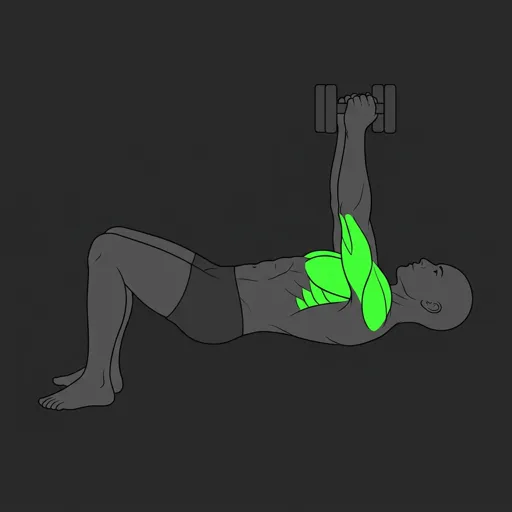
Step by step.
Sit on the floor holding a dumbbell in each hand, then lie back with your knees bent and feet planted.
Press the dumbbells up over your chest to arms length, palms facing forward. This is the start.
Lower under control until the back of your upper arms touches the floor. The elbows sit at roughly 45 degrees from your sides.
Pause on the floor for a beat. No bouncing the triceps off the ground to rebound the weight.
Drive the dumbbells back to lockout, squeezing the chest and triceps at the top.
Reset and repeat, keeping each rep deliberate rather than rushed.
The floor is the coaching tool here. It stops your arms before the deep stretch a bench gives, and that does two useful things at once. The press stays in the top half where the triceps do most of the driving, and the shoulder skips the vulnerable bottom entirely. Anyone whose shoulders complain on a full range dumbbell bench press can usually keep pressing hard from the floor.
Treat the pause as part of the lift. Let the triceps settle on the floor for a real beat and the stretch reflex dies, so you press back up with muscle and no bounce. That dead stop is what carries the floor press over to lockout on the close grip bench press and the bench in general. Bounce off the floor and the point is gone.
Elbow angle sets the bias. Wide elbows pull more chest into the press. Tuck them close to your sides and the triceps take the lead, in a pattern close to a skullcrusher but far kinder to the elbows. Choose the version that matches what you are bringing up and hold it across the set.
Press it for 6 to 10 as a main movement, or run the reps higher for a triceps finisher. Either way it suits two kinds of lifter. Home and garage trainees with dumbbells and no bench get a full press, and seasoned benchers get a fix for a stalling lockout.
Common questions.
The floor cuts the range short, stopping your arms before the deep stretch a bench allows. The work stays in the top half where the triceps drive lockout, and the shoulder dodges the exposed stretched position. It builds your lockout and gives sore shoulders a way to keep pressing.
Both, with your elbows setting the balance. Wide elbows bring in more chest, tucked elbows hand it to the triceps. Because the range stops high, the triceps and the lockout get extra emphasis either way, more than they would in a full range dumbbell bench press.
Yes. A real pause with the triceps resting on the ground kills the bounce, so you press up with strength rather than momentum. That dead stop is what carries over to lockout on the close grip bench press and the regular bench. Bouncing defeats the exercise.
Often, yes. Cutting out the deep bottom keeps the shoulder clear of the position that usually causes pressing pain, so many lifters who hurt on a full bench can train the floor press hard. It is not a cure for an injury, but as a pain free pressing option it is hard to beat.


Run the numbers.
One-rep max.
Estimate your max from any rep count. Five formulas, full percentage table.
Plate calculator.
What to load for any target weight, in lb or kg.
RPE calculator.
Convert rate of perceived exertion to training percentages.
Wilks score.
Bodyweight-adjusted total for comparing strength across weight classes.
DOTS score.
The IPF's newer bodyweight-adjusted scoring formula.
IPF GL points.
The IPF's official Goodlift score, in use at meets since 2020.
Volume calculator.
Weekly sets per muscle group, tonnage, and load management.
Strength ratio.
Screen your squat, bench, and deadlift to find the lift that is lagging.
Stop calculating.
Start tracking.
Log every set in RepRaptor. Free forever for lifters.