Overhead Squat.
The overhead squat holds a barbell locked out overhead with a wide grip while you squat to full depth. It is the ultimate test of mobility, stability, and position, exposing every restriction and weakness in the body at once.

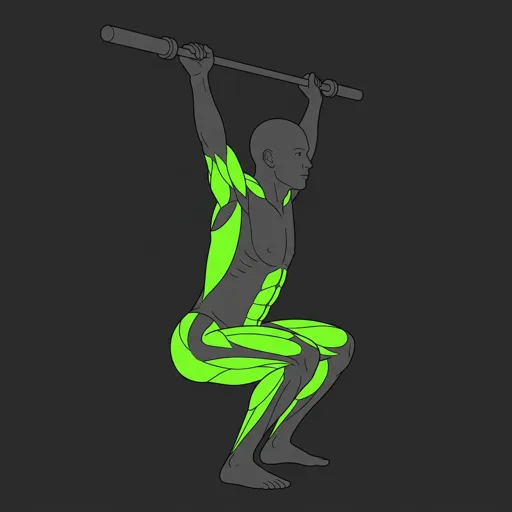
Step by step.
Take a wide snatch grip on the bar and press or jerk it to a locked out position overhead, arms straight.
Set your feet slightly wider than shoulder width with toes turned out, the bar stacked over your midfoot. This is the start.
Brace hard and squat down by bending the hips and knees, keeping the bar directly overhead.
Descend until your thighs are at least parallel, holding the bar back and the chest up.
Keep your arms locked and the shoulder blades active throughout.
Drive up through the feet to standing, keeping the bar stacked overhead the whole way.
The overhead squat hides nothing. Just to perform it you need ankle, hip, thoracic, and shoulder mobility cooperating, plus the core stability to hold a bar locked overhead while you sit into a deep squat. Let any one of those slip and the lift unravels, which is why coaches use it as a diagnostic. Watch someone overhead squat and their restrictions announce themselves. A bad rep is information, not a verdict, so read it and go work on what it shows.
Think of it as a mobility and skill lift first and a strength lift a distant second. The loads will always trail your back squat or front squat, because what caps you is holding position overhead, well before leg strength ever enters it. That is by design. Chase weight before the position is solid and you just dump the bar forward and put your shoulders at risk. Earn the depth and stability with a dowel or an empty bar before plates enter the picture.
Bar back, shoulders working. The lift most often breaks when the bar drifts forward on the way down, tipping you onto your toes and out of position. Pull the bar back over the base of your neck and press up into it with active shoulder blades so it stays stacked over your midfoot from the top of the rep to the bottom.
Keep it light, 3 to 6 reps, and chase a clean position over a bigger number. It is invaluable for anyone training the snatch, since the catch is itself an overhead squat, and a humbling mobility and core builder for everyone else. Whatever your goal here, the position is the lift and the weight is an afterthought.
Common questions.
It demands ankle, hip, upper back, and shoulder mobility plus core stability all at once, while holding a bar locked overhead through a deep squat. If any one of those is lacking, the lift breaks down. That is why it is used as a diagnostic that reveals exactly where your restrictions are.
Because the limit is holding position overhead, not leg strength, so the load always trails your back squat or front squat. That is expected, not a problem to fix by adding weight. Build the position and stability with an empty bar or dowel first, then add plates slowly.
Pull the bar back so it sits over the base of your neck and press up into it with active shoulders, keeping the shoulder blades engaged. The bar should stay stacked over your midfoot top to bottom. Forward drift usually means passive shoulders or limited mobility tipping you onto your toes.
Anyone training the snatch, since the catch is itself an overhead squat, so the lift builds that position directly. For everyone else, it is a demanding mobility and core builder that exposes restrictions. Run it light for 3 to 6 reps with the focus on flawless position.


Run the numbers.
One-rep max.
Estimate your max from any rep count. Five formulas, full percentage table.
Plate calculator.
What to load for any target weight, in lb or kg.
RPE calculator.
Convert rate of perceived exertion to training percentages.
Wilks score.
Bodyweight-adjusted total for comparing strength across weight classes.
DOTS score.
The IPF's newer bodyweight-adjusted scoring formula.
IPF GL points.
The IPF's official Goodlift score, in use at meets since 2020.
Volume calculator.
Weekly sets per muscle group, tonnage, and load management.
Strength ratio.
Screen your squat, bench, and deadlift to find the lift that is lagging.
Stop calculating.
Start tracking.
Log every set in RepRaptor. Free forever for lifters.