Power Snatch.
The power snatch pulls a barbell from the floor to overhead in one explosive movement, caught with the arms locked out in a partial squat. It is the most athletic of the barbell lifts, demanding speed, precision, and full body power.

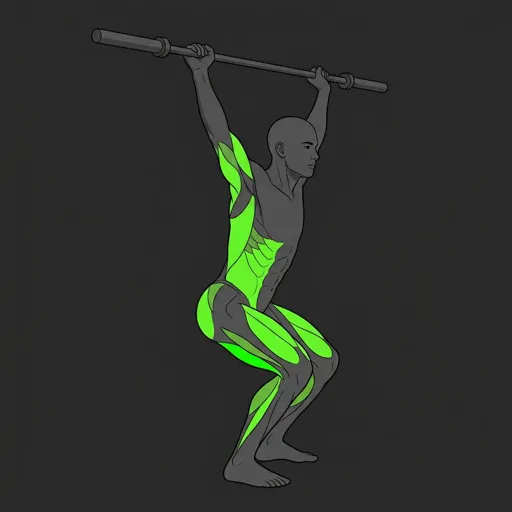
Step by step.
Set up over the bar with a wide snatch grip, feet under the hips, hips down, chest up, shoulders over the bar.
Begin the first pull by driving through the heels, raising the bar with the back angle held constant past the knees.
Hit the second pull by violently extending the hips, knees, and ankles, shrugging as the bar reaches the hip.
Pull yourself under the bar, punching the arms to lockout overhead.
Receive the bar locked out overhead in a partial squat, slightly wider stance.
Stand to full lockout with the bar stable over the back of your head.
A power snatch is the full snatch without the deep catch, and that single limit is what makes it trainable for most people. The full lift receives the bar in a deep overhead squat that asks for rare mobility, while the power version catches it higher in a partial squat, so you can train the explosive pull and the overhead receive without years of mobility work behind you. It is the snatch made accessible, and one of the most demanding tests of barbell power going, since nothing else asks you to move a load from floor to overhead this fast.
The wide grip and the overhead catch are what separate it from a clean. Where the hang clean and the power clean land the bar on the shoulders, the snatch finishes locked out overhead, which piles a brutal demand for shoulder stability and accuracy on top of the pull. Set the grip so the bar sits at your hip crease when you stand, and commit to punching into a hard locked elbow overhead. A soft, slow lockout is how the bar gets missed forward or back.
Keep the bar close and be patient off the floor. Two faults wreck snatches, the bar swinging out away from the body and a frantic yank off the floor. Brush the bar against your legs the whole way up, and let that first pull be controlled so you reach the hip in a position to detonate. Save the violence for the second pull.
This is a technical power lift, so keep the reps at 1 to 3, fresh and fast, and drill it light with precision ahead of load, since a missed heavy snatch teaches nothing good. Alongside the power clean, it is one of the two pillars of explosive barbell work.
Common questions.
The catch depth. A full snatch receives the bar in a deep overhead squat, demanding rare mobility, while a power snatch catches it higher in a partial squat. That makes the power version trainable for most lifters, building the explosive pull and overhead catch without the deep squat mobility.
A clean, including the hang clean and power clean, catches the bar on the shoulders in a front rack. The snatch uses a wider grip and catches it locked out overhead in one motion. That overhead catch adds a big demand for shoulder stability and accuracy on top of the pull.
Usually a soft or slow overhead lockout, or letting the bar drift away on the pull. Brush the bar close to your legs the whole way up, and punch hard and fast into a fully locked elbow. A committed lockout in the right position keeps the bar stacked over you.
Because it is a technical power lift, and power fades the instant you fatigue, so run around 1 to 3 reps fresh and fast with full rest. Drill it light and prioritize precision over load, since a missed heavy snatch builds bad habits. It pairs with the power clean as the two pillars of explosive barbell training.


Run the numbers.
One-rep max.
Estimate your max from any rep count. Five formulas, full percentage table.
Plate calculator.
What to load for any target weight, in lb or kg.
RPE calculator.
Convert rate of perceived exertion to training percentages.
Wilks score.
Bodyweight-adjusted total for comparing strength across weight classes.
DOTS score.
The IPF's newer bodyweight-adjusted scoring formula.
IPF GL points.
The IPF's official Goodlift score, in use at meets since 2020.
Volume calculator.
Weekly sets per muscle group, tonnage, and load management.
Strength ratio.
Screen your squat, bench, and deadlift to find the lift that is lagging.
Stop calculating.
Start tracking.
Log every set in RepRaptor. Free forever for lifters.