Push Press.
The push press uses a short dip and drive from the legs to launch a barbell overhead, letting you handle more weight than a strict press. It bridges raw pressing strength and explosive power, training the whole body to put a load over your head.

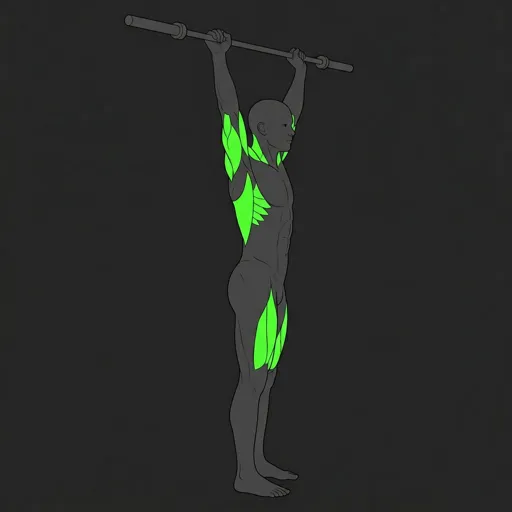
Step by step.
Set the bar in a front rack across your shoulders, hands just outside shoulder width, elbows up.
Brace your core and dip straight down a few inches by bending the knees, keeping your torso vertical.
Reverse hard, driving through the legs to launch the bar off your shoulders.
As the bar leaves, press it the rest of the way to a locked out position overhead.
Stand tall with the bar stacked over the back of your head, then lower it back to the front rack.
Reset your brace and rack position before the next rep.
The dip is short, vertical, and fast, and getting it wrong wrecks the whole lift. The single most common error is dipping too deep and too slow, which turns the leg drive into a squat and kills the elastic rebound that launches the bar. Think a few inches straight down and an instant reversal. Keep your torso vertical through the dip, because the moment you lean forward the bar drifts off your shoulders and out in front of you.
Be clear on what the push press is for. The leg drive lets you put more weight overhead than a strict overhead press allows, so you can overload the lockout and the supporting structure beyond what your shoulders could press alone. It is also a genuine power movement, a simpler cousin to the explosive triple extension you use in the power clean and the snatch, so it builds the ability to make force fast.
Keep the leg drive and the press connected. The legs start the bar, then the shoulders and triceps finish it, and that handoff should be smooth. If the bar stalls at your forehead, you either dipped too slow or stopped driving with the legs before the press took over. Drive through the floor until the bar is genuinely moving, then press.
Run it for sets of 3 to 6. It trains power and overloads the press, so speed and quality outrank grinding out one more rep. When the bar starts moving slow and ugly, the set is done.
Common questions.
The push press uses a short dip and leg drive to start the bar, while the strict overhead press uses only the shoulders and triceps. The leg assist lets you handle more, so the push press overloads the lockout and trains explosive power. The strict press builds purer shoulder strength.
Shallow, a few inches, and fast. The dip stores elastic energy that launches the bar, so a deep slow dip becomes a quarter squat and wastes the drive. Keep your torso vertical so the bar stays over your shoulders, then reverse instantly into the drive.
Either the dip was too slow to build any drive, or you stopped pushing with the legs before the shoulders took over. The leg drive and the press have to connect smoothly. Dip fast, drive through the floor until the bar is genuinely moving, then press it to lockout.
Yes. The dip and drive train you to produce force quickly through the legs and hips, the same triple extension behind the power clean and the snatch. It is a more accessible way to train overhead power than the full Olympic lifts, while also overloading your pressing. Keep the reps low and explosive.


Run the numbers.
One-rep max.
Estimate your max from any rep count. Five formulas, full percentage table.
Plate calculator.
What to load for any target weight, in lb or kg.
RPE calculator.
Convert rate of perceived exertion to training percentages.
Wilks score.
Bodyweight-adjusted total for comparing strength across weight classes.
DOTS score.
The IPF's newer bodyweight-adjusted scoring formula.
IPF GL points.
The IPF's official Goodlift score, in use at meets since 2020.
Volume calculator.
Weekly sets per muscle group, tonnage, and load management.
Strength ratio.
Screen your squat, bench, and deadlift to find the lift that is lagging.
Stop calculating.
Start tracking.
Log every set in RepRaptor. Free forever for lifters.