Snatch.
The snatch takes a barbell from the floor to locked out overhead in one continuous movement using a wide grip. It is the most technically demanding lift in the barbell canon. The bar travels the shortest path when technique is perfect, and the consequence of a missed position is usually a failed lift or a drop.

Step by step.
Set a wide grip on the bar, roughly 2x to 2.5x shoulder width, so the bar will sit over your shoulders when your arms lock overhead. Place the bar over the middle of your feet, drop your hips, flatten your back, and bring your shoulders over or just ahead of the bar.
Lift the bar off the floor under control, slower than a deadlift, and keep your back angle fixed as your legs straighten. Hold the bar close and let it travel up your thighs without swinging away from your body.
When the bar reaches your hips, drive your hips through and extend your ankles, knees, and hips fast to send the bar upward. Shrug and keep the bar near your body as it accelerates.
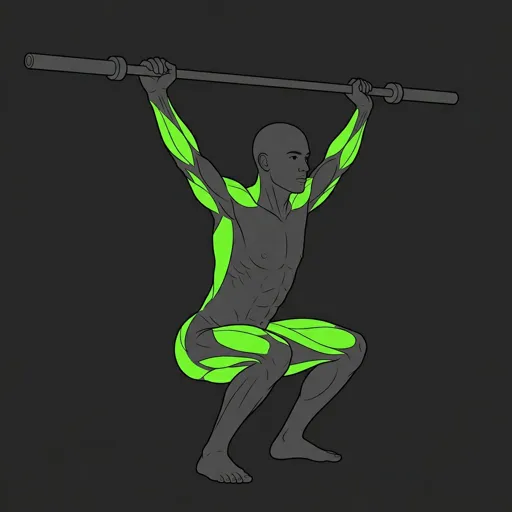
Pull yourself down under the rising bar and punch your arms straight up to lock the bar overhead. Receive it in an overhead squat, hips below parallel for a full snatch or higher for a power snatch, with the bar stacked over your shoulders and midfoot.
Hold the overhead position stable, then stand up out of the squat with the bar locked out. Lower or drop the bar under control to bumper plates and reset your grip for the next rep.
The grip width is the first thing to set, because everything else depends on it. Snatch grip is determined with the bar overhead: your arm position at lockout should have the bar sitting directly above your shoulder joint, with a slight elbow bend possible. Too narrow and the bar sits forward of the shoulder, which is unstable. Too wide and you can't generate enough lat tension during the pull. A common starting point: use a collar-to-knurling grip and adjust from there. Most lifters end up somewhere between 2x and 2.5x shoulder-width, hand-to-hand.
The first pull in the snatch is slower and more controlled than in the power clean, not more explosive. The goal is to maintain the exact back angle from the floor to the knee while the legs extend. The shoulders stay over or slightly in front of the bar. If the hips rise first, the bar swings away from the body on the way up. A bar path that deviates even a few centimeters from the body causes failures at the catch.
The turnover is the hardest skill to build. After the full hip extension and shrug, the elbows break and the lifter actively pulls their body under the bar rather than lifting the bar higher. This happens in about 0.15 seconds in an elite lift. For learning purposes, the high hang snatch (bar starts at the hip crease) is the best drill because it forces you to practice the turnover in isolation without the complexity of the full pull from the floor.
Overhead stability is a separate training problem from the pull. The snatch overhead squat (holding the wide grip with arms locked and squatting to depth) exposes shoulder mobility, thoracic extension, and ankle flexibility issues that will kill a catch. If you can't hold a stable overhead squat for reps at bodyweight, you can't safely catch a snatch. Address that first. Build toward the full lift with the power snatch for a higher catch, the snatch grip deadlift for the pull, and the hang clean to drill the turnover on a simpler movement.
Common questions.
The snatch takes the bar from floor to overhead in one uninterrupted movement. The clean and jerk is two separate movements: a clean that brings the bar to the front rack, rest, then a jerk that drives it overhead. Because the snatch must go directly to lockout in one pull, the grip is much wider (to shorten the bar's required travel distance) and less weight can be lifted than in the clean and jerk. At the Olympic level, snatch lifts are typically 15-20% lower than clean and jerk totals for the same athlete.
In a full snatch, the lifter catches the bar in a deep overhead squat (hips below parallel). In a power snatch, the catch happens with the hips above parallel, in a partial squat. Power snatches allow slightly less weight because the bar must travel higher before the catch. They're often used as accessory work or when the athlete is working on pull mechanics without the complexity of the full overhead squat catch. Both lifts start with the same first and second pull sequence.
The bar is going backward because it's too far behind the shoulder joint at lockout, or your shoulder mobility is the ceiling. A bar that drifts behind the head at the catch puts your shoulder in extreme internal rotation under load, and the joint can't hold it. The fix is usually one of: the turnover is happening too late (you're catching with the bar still moving backward), the grip is too narrow (limiting how far back the bar can sit), or thoracic extension is limiting overhead stability. Overhead squat work with a PVC pipe identifies the mobility issue quickly.
Yes. Failed snatches, especially as you learn the turnover and catch, result in the bar being dropped from overhead, sometimes with some force. Standard iron plates and standard gym floors don't handle that well. Bumper plates (rubber-coated Olympic plates) are designed to be dropped and protect both the bar and the platform. Attempting to learn the snatch on a concrete floor with iron plates, or in a gym that prohibits dropping weights, creates a situation where you can't safely miss a lift. Missing safely is part of learning.


Run the numbers.
One-rep max.
Estimate your max from any rep count. Five formulas, full percentage table.
Plate calculator.
What to load for any target weight, in lb or kg.
RPE calculator.
Convert rate of perceived exertion to training percentages.
Wilks score.
Bodyweight-adjusted total for comparing strength across weight classes.
DOTS score.
The IPF's newer bodyweight-adjusted scoring formula.
IPF GL points.
The IPF's official Goodlift score, in use at meets since 2020.
Volume calculator.
Weekly sets per muscle group, tonnage, and load management.
Strength ratio.
Screen your squat, bench, and deadlift to find the lift that is lagging.
Stop calculating.
Start tracking.
Log every set in RepRaptor. Free forever for lifters.