Snatch Grip Deadlift.
The snatch grip deadlift is a conventional pull taken with a very wide grip, which drops the hips lower and lengthens the range. It hammers the upper back, traps, and posterior chain harder than a standard pull at the same load.

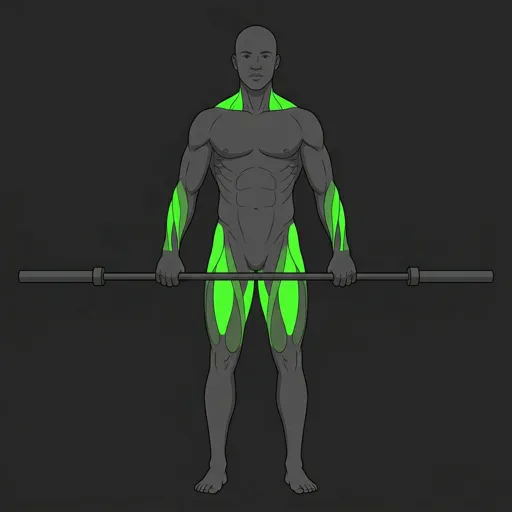
Step by step.
Stand with feet about hip width over the bar. Take a wide overhand grip, hands well outside the shoulders, near where you would grip for a snatch.
Drop the hips and set a flat back with the chest up. The wide grip forces a lower starting position than a normal deadlift.
Brace hard, take the slack out of the bar, then drive through the floor with hips and knees rising together.
Keep the bar dragging close to your body and hold your back angle off the floor.
Stand tall at lockout with the shoulders back, then lower under control along the same path.
Reset your grip and brace before every rep. The wide hands tax your grip fast.
Spread your hands out toward snatch width and everything downstream changes. Your shoulders sit lower, the bar starts closer to the floor, and the extra range at the bottom forces your hips down into a stronger upper back position. The payoff is a pull that hammers the traps, rhomboids, and the whole upper back far more than a conventional deadlift at the same weight, because they are fighting to hold position over a longer, nastier pull.
Expect the bar to feel brutal even with a smaller number on it. The longer range and the upper back demand mean you will use noticeably less than your regular deadlift or your sumo deadlift, and that is correct. People see the lighter load, try to close the gap, and round their backs at the bottom. Pick a weight you can start with a flat back from that deep position and leave the ego pulls alone.
Grip will be the limiter, and that is partly the point. The wide hands sit at a mechanical disadvantage, so the lift builds serious holding strength. Strap up only when grip is the single thing ending your sets and your target is the back. On a dedicated grip day, ditch the straps and let the hands fight.
Treat it as an accessory to your main pulling. Sets of 4 to 8 build a thick upper back and reinforce the position you want on the romanian deadlift and the conventional pull. Keep a couple of reps in reserve every set so your position holds, because this lift rewards clean reps over a grind.
Common questions.
The wide grip lowers your shoulders and hips and lengthens the range at the bottom. That puts much more demand on the upper back, traps, and rhomboids to hold position than a conventional pull at the same load. It is mainly an upper back and posterior chain builder rather than a way to lift more.
The longer range and harder upper back position make it genuinely tougher, so using well under your conventional deadlift or sumo deadlift is expected. The smaller number is not a problem to fix with more weight; chasing it just rounds your back. Load it for a flat back from the deep start.
When grip is the only thing ending your sets and the goal is to train the back, yes. The wide hands put grip at a disadvantage, so it fails before the back does. Straps keep the focus on the upper back and posterior chain. Training grip itself? Leave them off.
No. It began as assistance for the snatch, but it builds a thick upper back and reinforces deadlift positioning for anyone. Run it as an accessory in the 4 to 8 range to support your conventional and romanian deadlift work. You never have to touch a barbell snatch to benefit.


Run the numbers.
One-rep max.
Estimate your max from any rep count. Five formulas, full percentage table.
Plate calculator.
What to load for any target weight, in lb or kg.
RPE calculator.
Convert rate of perceived exertion to training percentages.
Wilks score.
Bodyweight-adjusted total for comparing strength across weight classes.
DOTS score.
The IPF's newer bodyweight-adjusted scoring formula.
IPF GL points.
The IPF's official Goodlift score, in use at meets since 2020.
Volume calculator.
Weekly sets per muscle group, tonnage, and load management.
Strength ratio.
Screen your squat, bench, and deadlift to find the lift that is lagging.
Stop calculating.
Start tracking.
Log every set in RepRaptor. Free forever for lifters.