Alternating Hammer Curl.
The alternating hammer curl curls dumbbells with a neutral grip, thumbs up, one arm at a time. The neutral grip shifts work onto the brachialis and forearm, building arm thickness that a palms up curl leaves out.

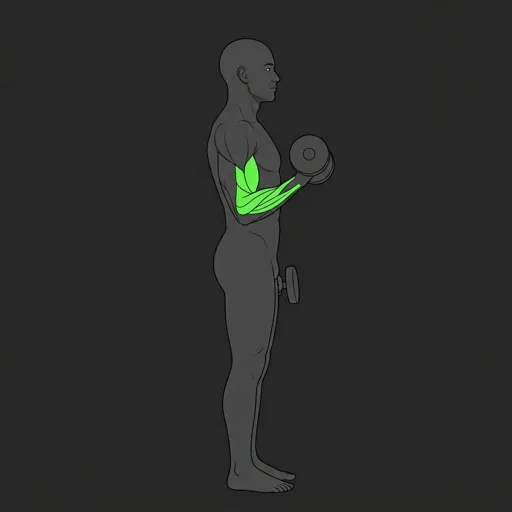
Step by step.
Stand tall with a dumbbell in each hand at your sides, palms facing your body, elbows tucked.
Keeping the upper arm still, curl one dumbbell up with the thumb staying on top throughout.
Bring it to shoulder level, squeeze, and hold for a beat.
Lower that arm slowly back to your side as you begin curling the other.
Alternate arms for the full set, keeping the torso still.
Do not swing or let the elbows drift forward to heave the weight.
Hammer curls turn the palms to face each other, and that neutral grip shifts where the load lands. With the thumbs up, the work shifts off the biceps proper and onto the brachialis, the muscle tucked underneath, plus the brachioradialis in the forearm. A well built brachialis pushes the biceps up and makes the whole upper arm look thicker, which is the bit a standing dumbbell bicep curl alone never quite fills out. Hammer curls cover what it misses.
Alternating earns its place. Working one arm at a time lets you put full attention on each rep and keeps the set from turning into a two armed swing once fatigue hits, the usual failure when both arms curl together. The resting arm also recovers a beat, so each rep stays crisp. If you tend to cheat curls, alternating slows you down enough to stay strict.
Keep the thumb up and the elbow pinned. The grip stays neutral the whole way; rotate toward palms up partway and you turn it back into a regular curl, undoing the brachialis bias. And like any curl, the upper arms stay at your sides. Swing them forward and the shoulders take over the work.
The brachialis and forearm are strong, so you can handle a bit more weight here than on a supinated curl. Run them in the 8 to 12 range and treat them as the move that adds the thickness a palms up curl leaves out.
Common questions.
The neutral, thumbs up grip shifts the load onto the brachialis and the brachioradialis of the forearm rather than the biceps alone. The brachialis sits under the biceps and pushes it up, so developing it makes the whole arm look thicker. A standard dumbbell bicep curl misses this, which is why hammer curls are a worthwhile addition.
Alternating lets you focus on each rep and keeps fatigue from turning the set into a double armed swing, which is the common breakdown when both arms work at once. The resting arm also recovers briefly between reps, so each one stays crisp. If you tend to cheat your curls, alternating naturally slows you down.
Usually a bit, yes. The brachialis and forearm are strong muscles and the neutral grip is a mechanically favorable position, so most lifters handle slightly more weight than on a supinated curl. Run them in the 8 to 12 range and keep the elbows pinned so the added load does not turn into a swing.
Yes. The neutral grip leans on the brachioradialis, a major forearm muscle, and gripping the dumbbells works the hands all set. Beyond the brachialis and arm thickness, that is real forearm and grip training, useful for pulling strength elsewhere.


Run the numbers.
One-rep max.
Estimate your max from any rep count. Five formulas, full percentage table.
Plate calculator.
What to load for any target weight, in lb or kg.
RPE calculator.
Convert rate of perceived exertion to training percentages.
Wilks score.
Bodyweight-adjusted total for comparing strength across weight classes.
DOTS score.
The IPF's newer bodyweight-adjusted scoring formula.
IPF GL points.
The IPF's official Goodlift score, in use at meets since 2020.
Volume calculator.
Weekly sets per muscle group, tonnage, and load management.
Strength ratio.
Screen your squat, bench, and deadlift to find the lift that is lagging.
Stop calculating.
Start tracking.
Log every set in RepRaptor. Free forever for lifters.