Dumbbell Bicep Curl.
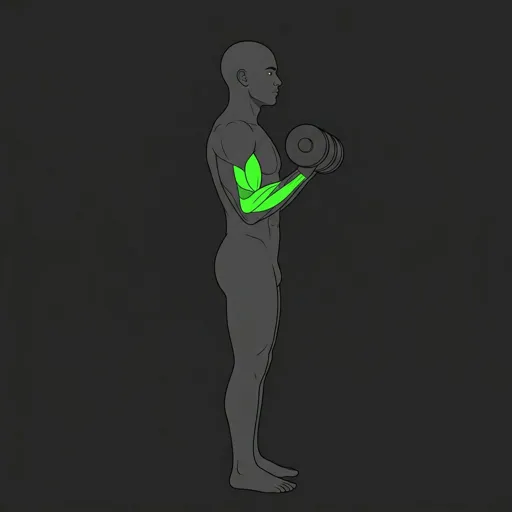
The dumbbell bicep curl trains the biceps brachii and brachialis through elbow flexion with a supinated grip. Both arms curl simultaneously, starting from full extension at the sides and finishing with the dumbbells at shoulder level, keeping the upper arms stationary throughout.

Step by step.
Stand tall with a dumbbell in each hand and your arms hanging straight down at your sides. Turn your palms to face forward in a supinated grip, which is what makes this a curl and not a hammer curl.
Pin your upper arms against your sides and keep them there for the whole set. They should not drift forward as you lift.
Curl both dumbbells up toward your shoulders by bending only at the elbows. Squeeze the biceps at the top without leaning back or swinging the weight up.
Lower the dumbbells slowly back down until your arms are fully straight. The lengthened position at the bottom is where a lot of the growth comes from, so do not cut it short.
Keep the elbows pinned through the descent and start the next rep from a full stretch.
Match your form on the last rep to your first. If the elbows start floating or the torso starts swinging, the weight is 5-10 lbs too heavy.
The upper arms need to stay pinned to the sides for the whole set. When the elbows drift forward on the way up (and they will, because it makes the weight easier to move) the anterior deltoid and shoulder contribute to the curl, and the bicep gets less of the work. The test is easy: if you're leaning back slightly at the top of each rep, your elbows have already moved forward of your torso and your shoulders are finishing what your biceps started. Pin the elbows and the lean disappears.
Full elbow extension at the bottom of each rep is the most commonly skipped part of bicep curling. People drop to 80-90% extension and start the next rep before the bicep is fully lengthened. The lengthened position under load is where a significant portion of hypertrophy stimulus comes from. Shortening the range consistently undertrains that part of the muscle. Lower the dumbbell until the arm is fully straight, feel the stretch, then curl.
Supinated grip from the start (palms forward) is what makes this a bicep curl and not a hammer curl. The supination is part of how the bicep produces force. The biceps is a supinator as well as an elbow flexor, and a palm-forward grip means both functions are working through the full range. Hammer curls (neutral grip, palms facing each other) load the brachialis and brachioradialis more. Both are worth training; they're genuinely different exercises despite looking similar.
One weight selection note that gets skipped: your form at rep 8 of 10 should look like your form at rep 1. If by rep 8 the elbows are floating, the torso is swinging, and the range is shortening, the weight is 5-10 lbs too heavy. Lower it. Accumulating reps with perfect elbow position produces more bicep growth than accumulating fatigue with a swing-and-hope approach. When you want variety, the incline dumbbell curl trains the stretched position, the concentration curl isolates hard, the drag curl keeps tension on the way up, and the alternating hammer curl shifts work to the brachialis.
Common questions.
Simultaneously is the standard for this exercise and produces a clean training stimulus on both arms at once. Alternating curls (one arm at a time) allow for a slight supination twist at the top (turning the pinky finger up) which some coaches argue increases the peak contraction of the bicep's short head. Both versions work. Simultaneously curling is more time-efficient; alternating allows for more focused attention to each arm and can help if one side is noticeably weaker. Most programs use simultaneous curls as the default and add alternating as a variation when needed.
A few likely causes: not training close to failure (going through the motions with a comfortable weight never provides enough stimulus for growth), cutting the range short at the bottom (missing the stretched position), or not adding weight over time. Bicep growth requires progressive overload like any other muscle. If you've been curling the same pair of 25 lb dumbbells for six months, your biceps have adapted to that load and stopped growing. The fix is progressive: add 2.5-5 lbs when you can complete all your sets with good form, or add a rep, or slow the tempo. Something has to change.
The barbell fixes the grip width and prevents wrist rotation through the range. Dumbbells allow each wrist to move independently and permit rotation. Some people find the barbell curl uncomfortable because it locks the wrists into a fixed supination angle that doesn't match their natural wrist anatomy. If your wrists hurt on barbell curls but not dumbbell curls, that's why. Both effectively train the biceps. Barbells allow slightly heavier loading and are common as the primary bicep movement; dumbbells add the rotation option and work each arm independently.
Yes. The biceps has two heads: the long head (outer) and the short head (inner). Different exercises hit them differently. Incline curls (arms behind the body) stretch the long head more than standing curls and add different stimulus. Preacher curls (arms in front of the body on a pad) load the short head at a longer range. Hammer curls train the brachialis, which sits under the bicep and makes the arm look larger from the front when developed. A complete arm training approach uses 2-3 curl variations, not just one. Dumbbell curls are a solid foundation. They're not the whole building.


Run the numbers.
One-rep max.
Estimate your max from any rep count. Five formulas, full percentage table.
Plate calculator.
What to load for any target weight, in lb or kg.
RPE calculator.
Convert rate of perceived exertion to training percentages.
Wilks score.
Bodyweight-adjusted total for comparing strength across weight classes.
DOTS score.
The IPF's newer bodyweight-adjusted scoring formula.
IPF GL points.
The IPF's official Goodlift score, in use at meets since 2020.
Volume calculator.
Weekly sets per muscle group, tonnage, and load management.
Strength ratio.
Screen your squat, bench, and deadlift to find the lift that is lagging.
Stop calculating.
Start tracking.
Log every set in RepRaptor. Free forever for lifters.