Cable Preacher Curl.
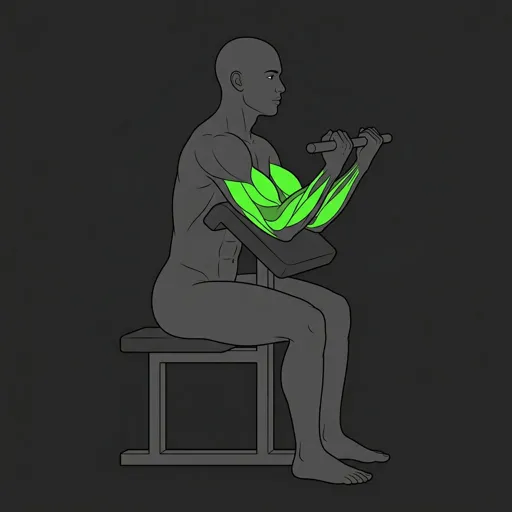
The cable preacher curl runs a preacher bench off a low pulley, so the biceps stay loaded at the bottom of the rep where a barbell goes slack. The angled pad locks the upper arm and the cable keeps tension through the full range.

Step by step.
Set a preacher bench a couple of feet in front of a low pulley with a straight bar attached.
Sit with the backs of your upper arms flat on the pad and take the bar at arms length. This is the start.
Curl the bar up toward your shoulders, squeezing the biceps hard at the top.
Hold the contraction for a beat, then lower slowly back to full extension.
Keep your upper arms glued to the pad the entire set.
Do not let the bar yank your arms straight at the bottom. Control the stretch.
A barbell preacher curl has a dead spot at the top. The stretched bottom is brutal, but as the bar nears your shoulders the tension fades, and at full extension a heavy barbell can yank the elbow. Run the movement off a low cable instead and the load stays steady through the whole range, including the contracted top, so the biceps never gets a breather. That constant tension is the reason to pick the cable.
The pad does the other half of the job. Resting your upper arms on the angled surface pins the elbows forward and down, killing any swing or shoulder help, so the rep stays as honest as a barbell curl done right. That forward elbow position also leans the work toward the short head of the biceps, the inner part, which a stretch movement like the incline curl tends to underwork.
Respect the bottom. With the elbow braced, a hard yank at full extension stresses the biceps tendon, which is where greedy lifters get hurt on preacher work. Lower under control, stop just short of a violent lockout, and keep the cable tension smooth rather than letting it snap your arm straight.
It is finishing work, best at twelve to fifteen reps with a real squeeze and a pause at the top. Let the constant tension pile up quality volume.
Common questions.
A barbell preacher curl loses tension near the top and goes nearly weightless at full extension, where it can also yank the elbow. A cable keeps steady tension through the entire range, including the squeeze at the top, so the biceps stays loaded the whole rep. The constant tension is the main reason to pick the cable version.
The forward elbow position on the preacher pad biases the short head, the inner part of the biceps. That makes it a good complement to stretch focused movements like the incline curl, which lean on the long head. Running both gives the biceps work in both the stretched and contracted positions.
Usually a hard, fast lockout at the bottom. With the elbow braced on the pad, snapping the arm straight under load stresses the biceps tendon at the elbow. Lower under control, stop just short of a violent full extension, and keep the cable tension smooth. If it still hurts, lighten the load and slow the lowering.
Use it alongside barbell preacher curls. The cable holds tension where the barbell goes slack, so it shines as finishing volume after your heavier curls, high reps with a squeeze and a hold at the top.


Run the numbers.
One-rep max.
Estimate your max from any rep count. Five formulas, full percentage table.
Plate calculator.
What to load for any target weight, in lb or kg.
RPE calculator.
Convert rate of perceived exertion to training percentages.
Wilks score.
Bodyweight-adjusted total for comparing strength across weight classes.
DOTS score.
The IPF's newer bodyweight-adjusted scoring formula.
IPF GL points.
The IPF's official Goodlift score, in use at meets since 2020.
Volume calculator.
Weekly sets per muscle group, tonnage, and load management.
Strength ratio.
Screen your squat, bench, and deadlift to find the lift that is lagging.
Stop calculating.
Start tracking.
Log every set in RepRaptor. Free forever for lifters.