Preacher Curl.
The preacher curl pins the upper arms against an angled pad, removing the possibility of elbow drift or body swing. The EZ bar is curled from near-full extension to shoulder height while the upper arms stay fixed against the bench, isolating the biceps more strictly than any standing curl variation.

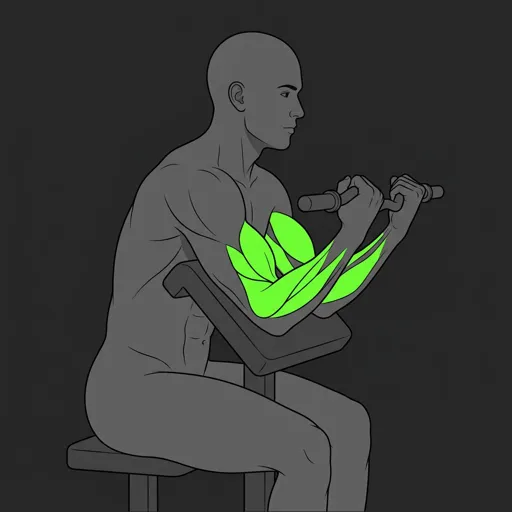
Step by step.
Set the seat so the top of the pad sits in your armpits when you sit down. Grab the EZ bar on the inner angled handles with your palms up and rest the backs of your upper arms flat against the pad.
Press both upper arms into the pad and let the bar lower until your elbows are nearly straight, keeping a slight bend so the tendon stays loaded but not snapped taut. That bottom position, arms long but not locked, is where each rep begins.
Curl the bar up by bending your elbows and squeezing the biceps, bringing the bar toward your shoulders. Keep your upper arms glued to the pad the whole way and do not lift your elbows to finish the top.
Pause briefly at the top where the biceps are fully contracted. Keep your wrists firm and your shoulders down rather than shrugging the bar up.
Lower the bar back down slowly under control to that slight bend at the bottom. Resist the weight the whole way and never let it drop into a full locked out elbow.
The bottom of a preacher curl is the dangerous part, and most people don't know it until they've already strained something. When the arm reaches near-full extension at the bottom of the rep, the biceps tendon at the elbow is under significant stretch while still supporting load. If you drop the bar to full lockout and let it snap taut, that tendon takes the full force of the deceleration. Don't go to complete elbow lockout under load. Stop with a slight bend remaining (maybe 10-15 degrees) and keep the eccentric controlled the whole way down.
The pad angle means the long head of the biceps (the outer, peaking head) is actually disadvantaged here compared to a standard barbell curl. The preacher shortens the long head by placing the upper arm in a flexed position against the pad, so you're primarily loading the short head and the brachialis. This is useful if short head development is lagging, but it also means the preacher curl is not a substitute for incline dumbbell curls if long head work is the goal. Both have a place.
On the EZ bar: the inner handles put the wrist in a semi-supinated position. This is less bicep-optimal than full supination on a straight bar, but the discomfort difference for most people makes the EZ bar the correct default. If you want to maximize supination, use a straight bar at the risk of wrist irritation, or use dumbbells for full supination range.
Keep the upper arms pressed into the pad for the entire set. Lifting the elbows off the pad to complete the last inch of a rep at the top is a cheat. The movement is already over when the elbows lift. If the elbows come off, the weight is too heavy.
Common questions.
Because the cheat is gone. Standing curls let the torso swing and the elbows drift forward to generate momentum and reduce the load on the biceps. The preacher bench removes both of those completely. The upper arm is fixed, the body can't rock, and the biceps does all the work through the full range. Expect to use significantly less weight than your standing curl. That's the point, not a sign of weakness.
Not under load. The biceps tendon at the elbow joint is vulnerable when the arm is near-fully extended and still supporting weight. Going to complete lockout and letting the weight hang at the bottom puts a sudden tensile stress on that tendon. Stop with a small bend remaining (10-15 degrees) and lower with control rather than letting the weight pull the arm down. Biceps tendon injuries at the elbow are slow to heal and happen more often on preacher curl variations than on standing curls for exactly this reason.
Yes. Dumbbell preacher curls have the advantage of allowing full supination. You can rotate the wrist to a fully supinated position at the top of each rep, which maximally contracts the biceps brachii. With a barbell or EZ bar, the grip is fixed. Single-arm dumbbell preacher curls also let you identify and correct asymmetries between sides. The tradeoff is that loading is capped at whatever dumbbells your gym has, and the movement gets slower since you're doing one arm at a time.
Neither is objectively better. They train the biceps from different mechanical positions. The preacher curl emphasizes the short head and brachialis due to the pad placing the upper arm in a forward position, which shortens the long head. The standing barbell curl, particularly with a full arm extension at the bottom, loads the long head more through a longer stretch position. For complete bicep development, both variations earn a spot over a training week, not just one or the other.


Run the numbers.
One-rep max.
Estimate your max from any rep count. Five formulas, full percentage table.
Plate calculator.
What to load for any target weight, in lb or kg.
RPE calculator.
Convert rate of perceived exertion to training percentages.
Wilks score.
Bodyweight-adjusted total for comparing strength across weight classes.
DOTS score.
The IPF's newer bodyweight-adjusted scoring formula.
IPF GL points.
The IPF's official Goodlift score, in use at meets since 2020.
Volume calculator.
Weekly sets per muscle group, tonnage, and load management.
Strength ratio.
Screen your squat, bench, and deadlift to find the lift that is lagging.
Stop calculating.
Start tracking.
Log every set in RepRaptor. Free forever for lifters.