Hammer Curl.
The hammer curl trains the brachialis and brachioradialis with a neutral grip (thumbs pointing up, palms facing each other). The wrist does not rotate during the movement. Both dumbbells curl from arms-length at the sides to shoulder height while the upper arms stay fixed.

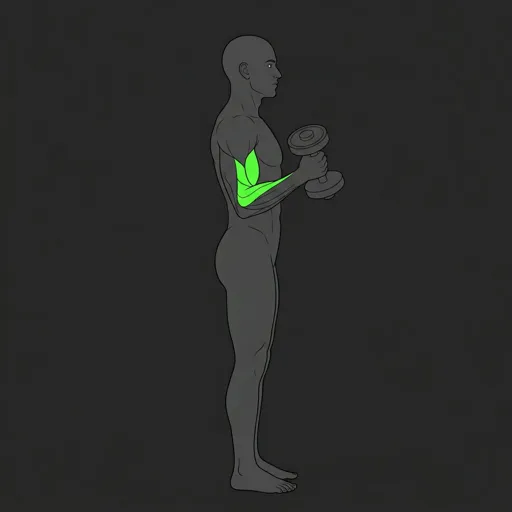
Step by step.
Stand tall with a dumbbell in each hand, arms hanging at your sides. Turn your hands so the palms face each other and the thumbs point forward.
Pin your upper arms against your sides and brace your trunk. Your elbows are the only hinge here, so keep them tucked and still.
Curl both dumbbells up toward your shoulders by bending at the elbows. Keep the thumbs pointing up the entire way so the palms stay facing in.
Stop when the dumbbells reach roughly shoulder height and your palms face your shoulders, not the ceiling. Squeeze for a beat at the top.
Lower the dumbbells slowly back to your sides under full control, resisting the weight on the way down. Let the arms straighten fully before the next rep.
Keep the torso quiet throughout. If you have to swing the hips or lean back to move the weight, the dumbbells are too heavy.
The wrist rotation is the most common technique error, and it defeats the exercise's specific purpose. Supinating at the top (rotating the palm upward to face the ceiling as the weight reaches shoulder height) shifts the load from the brachialis to the biceps brachii. That's fine if you want a bicep exercise. The hammer curl exists specifically because the brachialis is better trained in a neutral grip position and tends to be underdeveloped in lifters who only do supinated curls. Keep the thumb up for the entire rep. The palm faces your shoulder at the top, not the ceiling.
The brachialis sits under the biceps and pushes the bicep peak upward when developed. It's responsible for a significant chunk of upper arm thickness that supinated curls don't fully address. Brachioradialis development also gives the forearm that full, muscular look from the elbow toward the thumb side. Both of these respond primarily to neutral-grip loading.
On the alternating versus simultaneous rep question: most instructions show both arms curling at once, but alternating arms is also valid and lets you focus on each side's contraction separately. The limitation of alternating is pacing. It's easy to rush and turn it into a rhythm exercise rather than a controlled one. If alternating, treat each arm as a separate rep: full stop at the bottom before the next arm goes.
Hammer curls also tend to be more elbow-friendly than straight-bar curls for lifters with lateral epicondyle sensitivity, because the neutral grip reduces the supination stress that aggravates the lateral forearm structures. If barbell curls cause elbow discomfort, hammer curls are often the right substitution rather than a workaround.
Common questions.
The brachialis is the primary target. It runs beneath the biceps brachii and is most active in a neutral grip position. The brachioradialis (the large muscle on the thumb side of the forearm) is a significant secondary mover. The biceps brachii is active but not the dominant muscle in neutral grip, which is exactly what makes the hammer curl a distinct exercise rather than a bicep curl variant.
Yes. They train different muscles. The barbell curl targets the biceps brachii, particularly the long head, through supinated elbow flexion. The hammer curl targets the brachialis and brachioradialis through neutral grip elbow flexion. Including both exercises builds complete upper arm development. The bicep peak from supinated work plus the thickness and mass from neutral grip work. Most arm training programs that neglect hammer curls end up with a narrow arm profile despite large biceps.
Yes, using a rope attachment on a low cable pulley. Cable hammer curls maintain constant tension throughout the full range of motion, whereas dumbbell curls have near-zero tension at the bottom and maximum tension at the 90-degree elbow angle. The cable variation is a useful addition on high-volume days or when the dumbbells needed aren't available. Technique is the same: neutral wrist, elbows pinned to the sides, no rotation through the movement.
Most lifters can hammer curl slightly less than they can barbell curl with strict form, because the brachialis is a smaller muscle than the biceps. A rough starting point is 70-85% of your strict barbell curl weight. Still, the weight is the wrong focus. The grip staying neutral and the upper arm staying stationary is more important than the number on the dumbbell. If the wrist rotates before you reach shoulder height, the dumbbell is too heavy.


Run the numbers.
One-rep max.
Estimate your max from any rep count. Five formulas, full percentage table.
Plate calculator.
What to load for any target weight, in lb or kg.
RPE calculator.
Convert rate of perceived exertion to training percentages.
Wilks score.
Bodyweight-adjusted total for comparing strength across weight classes.
DOTS score.
The IPF's newer bodyweight-adjusted scoring formula.
IPF GL points.
The IPF's official Goodlift score, in use at meets since 2020.
Volume calculator.
Weekly sets per muscle group, tonnage, and load management.
Strength ratio.
Screen your squat, bench, and deadlift to find the lift that is lagging.
Stop calculating.
Start tracking.
Log every set in RepRaptor. Free forever for lifters.