Concentration Curl.
The concentration curl braces the working arm against the inner thigh and curls a single dumbbell with zero body involvement. Bracing the elbow makes it the strictest curl there is, which is why it tops studies on biceps activation.

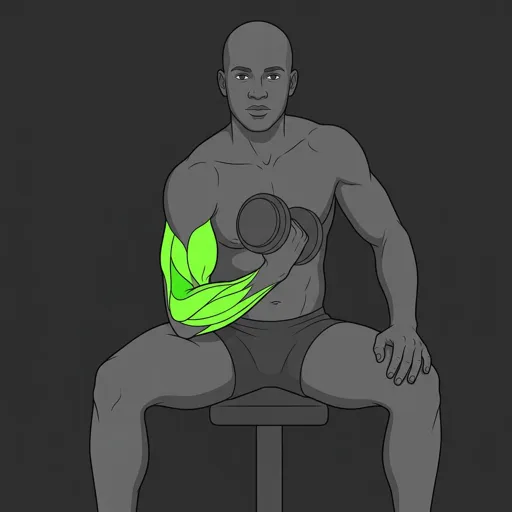
Step by step.
Sit on a bench with your legs spread, a dumbbell between your feet. Pick it up in one hand.
Plant the back of your upper arm against the inside of your thigh, arm extended toward the floor. This is the start.
Curl the dumbbell up toward your shoulder, keeping the upper arm pinned to your thigh.
Turn the pinky slightly higher than the thumb at the top for a full contraction, and squeeze.
Lower the dumbbell slowly back to full extension. No swinging.
Finish all reps on one arm, then switch.
Pin the back of your upper arm to your thigh and the swing disappears. With the elbow braced against the leg, you cannot heave the dumbbell up with the shoulder or a little back lean, so the biceps works in near total isolation. That is not a marketing line either. The concentration curl regularly comes out on top when researchers measure biceps activation across curl variations, precisely because nothing else can pitch in.
Use the brace to hunt for the contraction. Because one arm works at a time and the elbow is fixed, you can feel the biceps through the whole range, which makes this a fine teaching tool for the mind muscle connection. If your dumbbell bicep curl never feels like much, a few weeks of concentration curls will show you what a working biceps is supposed to feel like.
Twist for the peak. Supinating a touch more at the top, so the pinky finishes slightly higher than the thumb, drives a harder contraction, since one of the jobs of the biceps is turning the palm up. Small detail, big difference on the squeeze.
Keep it light to moderate for 10 to 15 reps per arm, slow on the way down, with a hard squeeze at every top. This is closing work. It belongs at the end of arm day, once your heavier curling has already done the strength job.
Common questions.
For pure biceps activation, it consistently ranks at the top in studies, because bracing the elbow against the thigh removes all the body help that other curls allow. That does not make it the only curl you need, since it is a light isolation movement, but it is the strictest way to work the biceps and a great peak contraction finisher.
The brace locks the upper arm so you cannot swing the dumbbell up with momentum, the shoulder, or a back lean. That forces the biceps to do everything, which is why the concentration curl isolates the muscle so well. It also lets you feel the biceps working through the full range, making it a good tool for building the mind muscle connection.
Yes. Supinating a little more at the top so your pinky finishes higher than your thumb drives a stronger biceps contraction, because turning the palm up is part of what the biceps does. It is a small adjustment that noticeably improves the squeeze. Keep it controlled rather than flicking the wrist.
Yes, as the polish at the end. It is a light isolation move, so do not load it heavy. Ten to fifteen reps per arm with a slow lowering and a hard squeeze, placed after your heavier barbell or dumbbell curling, is where it does the most.


Run the numbers.
One-rep max.
Estimate your max from any rep count. Five formulas, full percentage table.
Plate calculator.
What to load for any target weight, in lb or kg.
RPE calculator.
Convert rate of perceived exertion to training percentages.
Wilks score.
Bodyweight-adjusted total for comparing strength across weight classes.
DOTS score.
The IPF's newer bodyweight-adjusted scoring formula.
IPF GL points.
The IPF's official Goodlift score, in use at meets since 2020.
Volume calculator.
Weekly sets per muscle group, tonnage, and load management.
Strength ratio.
Screen your squat, bench, and deadlift to find the lift that is lagging.
Stop calculating.
Start tracking.
Log every set in RepRaptor. Free forever for lifters.