Drag Curl.
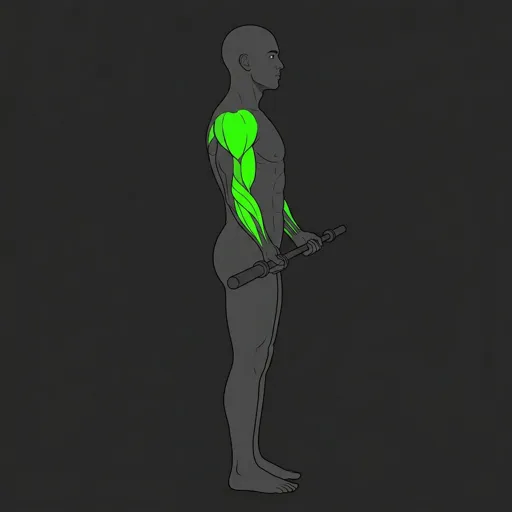
The drag curl keeps the bar dragging up against the torso while the elbows travel back, instead of swinging forward like a normal curl. That path keeps tension on the biceps the whole way and emphasizes the long head.

Step by step.
Stand holding a barbell with a supinated grip, palms forward, the bar resting against your thighs.
Curl the bar up while pulling your elbows back behind you, dragging the bar up the front of your torso.
Keep the bar in contact with your body the whole way up. It travels straight up, not out in an arc.
Bring it as high as you can while still dragging, then squeeze the biceps.
Lower slowly back down the torso to the thighs, keeping contact and tension.
Do not lift the shoulders or let the bar swing away from the body.
A drag curl runs the bar straight up your torso while the elbows travel back, the reverse of a normal curl arc. In a standard barbell curl the elbows stay pinned and the bar swings forward, giving the biceps a brief rest at the bottom and top. Drag the elbows back instead and the bar climbs the front of your body with the biceps under tension the entire way, no easy spots. It is constant tension built into a free weight.
Pulling the elbows behind the body also shifts emphasis toward the long head of the biceps, the outer portion that builds the peak. That makes it a useful change of pace from the standard dumbbell bicep curl, which keeps the elbows forward and spreads the work more evenly. Few barbell movements bias the peak like this one does.
Expect to use less weight, so park the ego. The mechanics are harder and the long head sits in a weaker position, so the load drops. Try to muscle a heavy bar and the drag collapses back into a regular swinging curl. Keep the bar glued to your torso. The moment it floats away from your body, the exercise is gone.
Run it for moderate reps, around 10 to 12, when your standard curls go stale or your peak needs attention. The constant tension makes it feel heavier than the bar reads, so let the burn tell you when the set is done.
Common questions.
In a normal curl the elbows stay forward and the bar swings up in an arc. In a drag curl the elbows pull back as you lift, so the bar drags straight up your torso. That keeps the biceps under constant tension with no rest spots and shifts emphasis to the long head. It is essentially a constant tension curl done with a barbell.
It biases the long head, the outer portion that builds the biceps peak, because pulling the elbows behind the body lengthens that head. A standard dumbbell bicep curl keeps the elbows forward and works the muscle more evenly. The drag curl is one of the few barbell ways to bias the peak specifically.
The path is mechanically harder and the long head works from a weaker position, so the load naturally drops. The constant tension also means no easy points to rest. Using less weight is expected. Trying to go heavy just makes the bar swing away from your body and turns it back into a regular curl.
When your standard curls feel stale or your biceps peak is lagging. Keep the bar against your torso for every rep and run around 10 to 12 reps a set.


Run the numbers.
One-rep max.
Estimate your max from any rep count. Five formulas, full percentage table.
Plate calculator.
What to load for any target weight, in lb or kg.
RPE calculator.
Convert rate of perceived exertion to training percentages.
Wilks score.
Bodyweight-adjusted total for comparing strength across weight classes.
DOTS score.
The IPF's newer bodyweight-adjusted scoring formula.
IPF GL points.
The IPF's official Goodlift score, in use at meets since 2020.
Volume calculator.
Weekly sets per muscle group, tonnage, and load management.
Strength ratio.
Screen your squat, bench, and deadlift to find the lift that is lagging.
Stop calculating.
Start tracking.
Log every set in RepRaptor. Free forever for lifters.