Decline Dumbbell Bench Press.
The decline dumbbell bench press works the lower chest on a head down bench while letting each arm move on its own. The dumbbells allow a deeper stretch and a more natural path than a barbell fixes you into.

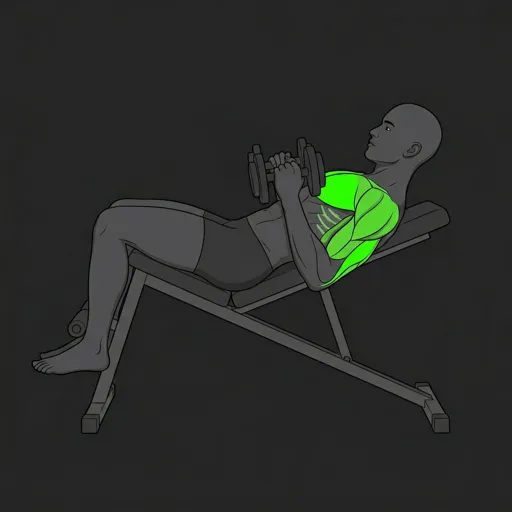
Step by step.
Anchor your legs at the top of a decline bench and lie back holding a dumbbell on each thigh.
Kick the dumbbells up one at a time and press them to arms length over your lower chest, palms facing forward.
Lower the dumbbells out and down to the sides of your lower chest, keeping the forearms vertical the whole way.
Let them sink until you feel a stretch across the pecs, deeper than a barbell allows since nothing is in the way.
Press back up and slightly together, squeezing the chest at the top without clacking the bells.
Control the descent on every rep. The dumbbells punish anyone who just drops them.
Dumbbells fix the one thing the bar version cannot. A barbell pins your hands to a single width, but here each arm settles into its own groove and dips lower at the bottom, so you reach a deeper chest stretch than the decline barbell bench press allows. Spend that range. Let the bells travel.
The cost is stability. Two free weights on a head down bench is a balance test, and you will watch the dumbbells wobble or drift apart as you tire. That is also the upside, because each arm has to carry itself and a lagging side gets caught out instead of coasting on the strong one. Plan on noticeably less total load than the barbell decline and do not chase the gap.
The genuinely awkward part is getting heavy bells into place while head down. Kick them up off your thighs one at a time, or better, have a partner hand them to you. Do not try to muscle two heavy dumbbells overhead from a dead hang while hanging upside down.
Build with it in the 8 to 12 range where the stretch earns its keep. Save your heavy triples for the barbell version and the flat dumbbell bench press, which hit the same lower chest target with more load and less wobble.
Common questions.
When you want range of motion and even left to right strength. Each arm works alone, so it sinks into a deeper stretch and forces a weak side to pull its weight. Reach for the bar instead when the goal is maximum load on the lower chest. Plenty of lifters rotate both across a block.
Balancing two separate dumbbells on a head down bench takes far more stability than a fixed bar, and neither arm can quietly borrow from the other. The lighter number is normal, and the tradeoff buys you longer range and more even development.
Rest them on your thighs as you lie back, then knee them up to your shoulders one leg at a time. For anything genuinely heavy, have a partner hand them off. Pressing them up from a dead hang while inverted is how shoulders get hurt.
Until you feel a real stretch across the chest, which on dumbbells runs deeper than a bar permits since nothing blocks the path. Stop short of the point where the shoulders feel pried open. Depth is the advantage here, so use what your shoulders tolerate cleanly.


Run the numbers.
One-rep max.
Estimate your max from any rep count. Five formulas, full percentage table.
Plate calculator.
What to load for any target weight, in lb or kg.
RPE calculator.
Convert rate of perceived exertion to training percentages.
Wilks score.
Bodyweight-adjusted total for comparing strength across weight classes.
DOTS score.
The IPF's newer bodyweight-adjusted scoring formula.
IPF GL points.
The IPF's official Goodlift score, in use at meets since 2020.
Volume calculator.
Weekly sets per muscle group, tonnage, and load management.
Strength ratio.
Screen your squat, bench, and deadlift to find the lift that is lagging.
Stop calculating.
Start tracking.
Log every set in RepRaptor. Free forever for lifters.