EZ Bar Curl.
The EZ bar curl uses the angled grips of an EZ bar to curl with the wrists turned slightly inward. That semi supinated grip eases the strain a straight bar puts on the wrists while still loading the biceps heavily.

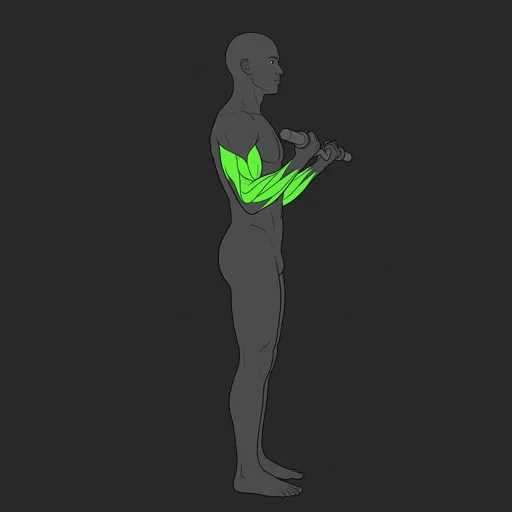
Step by step.
Stand tall holding an EZ bar on the angled outer grips, palms forward and slightly turned in, elbows at your sides.
Keep the upper arms still and curl the bar up by contracting the biceps. This is the rep.
Bring the bar to shoulder level, squeeze hard, and hold for a beat at the top.
Lower slowly back to full extension, keeping tension on the biceps.
Keep the elbows pinned to your sides. Do not let them swing forward.
Avoid heaving with the lower back. If the torso moves to lift the bar, lighten up.
The angled grips are a wrist saver. A straight barbell curl forces the wrists into full supination and holds them there, which plenty of lifters feel as a nagging strain at the wrist or elbow. The EZ bar lets the hands rotate slightly inward to a more natural angle, taking that twist off the joints while still loading the biceps hard. If straight bar curls bug your wrists, this is the obvious swap.
You give up a little biceps for a lot of comfort, and that trade usually pays. Full supination on a straight bar does recruit the biceps a touch more, since turning the palm all the way up is one of its jobs, so the EZ grip surrenders a sliver of that. For most people, loading heavier and training pain free more than covers the difference. Save the fully supinated work for the days your wrists feel up to it.
Pin the elbows and quit swinging. A comfortable grip tempts you to load up, and heavier weight invites the classic curl cheat, rocking the torso and throwing the elbows forward to fling the bar. Lock the upper arms at your sides so the biceps does the lifting. If you cannot, the bar is too heavy.
This is a strong main curl for biceps mass, run in the 8 to 12 range. Build your arm work on it as the heavy base, then move to stricter, lighter movements like the preacher curl to finish off.
Common questions.
The angled grips let your wrists turn slightly inward instead of locking into full supination like a straight bar forces. That takes strain off the wrists and elbows, so lifters who feel curls in their joints can train comfortably. It is the standard fix for wrist discomfort on a straight barbell curl, not a beginner shortcut.
Slightly. Full supination on a straight bar recruits the biceps a touch more because turning the palm fully up is one of its functions. The EZ grip gives up a small amount of that, but it lets most people load heavier and curl pain free, which usually outweighs the minor difference. Use a straight bar when your wrists allow it.
Because you are swinging the torso to heave the weight up. When the bar is too heavy, lifters rock back and use the lower back and hips to fling it, which strains the spine and takes work off the biceps. Pin your elbows to your sides, keep the torso still, and drop the weight until the biceps can do the lift cleanly.
Yes. The comfortable grip lets you load it heavy and progress, making it a strong primary mass builder for the biceps in the 8 to 12 range.


Run the numbers.
One-rep max.
Estimate your max from any rep count. Five formulas, full percentage table.
Plate calculator.
What to load for any target weight, in lb or kg.
RPE calculator.
Convert rate of perceived exertion to training percentages.
Wilks score.
Bodyweight-adjusted total for comparing strength across weight classes.
DOTS score.
The IPF's newer bodyweight-adjusted scoring formula.
IPF GL points.
The IPF's official Goodlift score, in use at meets since 2020.
Volume calculator.
Weekly sets per muscle group, tonnage, and load management.
Strength ratio.
Screen your squat, bench, and deadlift to find the lift that is lagging.
Stop calculating.
Start tracking.
Log every set in RepRaptor. Free forever for lifters.