Flat Bench Cable Flyes.
Flat bench cable flyes isolate the mid chest by lying on a flat bench set between two low pulleys. The cables hold tension across the full arc, so the chest stays loaded at the top where dumbbell flyes give out.

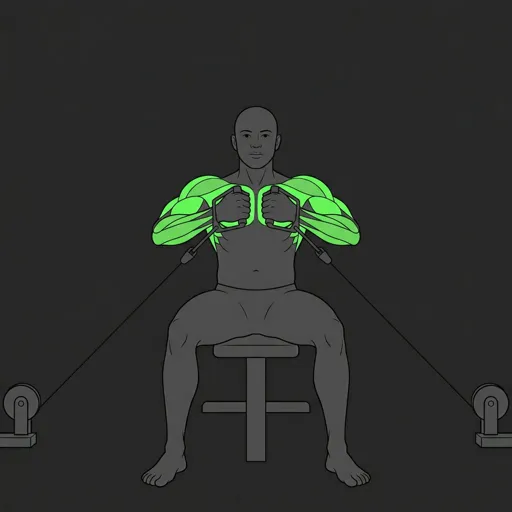
Step by step.
Line a flat bench up centered between two low pulleys so your chest sits level with the cable origins.
Lie back, feet on the floor, and take a handle in each hand with a palms up grip.
Press your arms out to the sides with a fixed slight bend in the elbows, arms roughly parallel to the floor. This is the start.
Pull the handles up and together in a wide semicircle until they meet above your chest.
Squeeze the chest hard at the top and hold for a beat, where the cables are still loading you.
Lower along the same arc under control until you feel the stretch, then repeat.
Lying down is the upgrade over standing cable work. On a standing crossover a little balance and a little lean sneak into every rep, but pinned flat to a bench the only thing that can move the handles is your chest. That makes the flat bench version one of the cleanest mid chest isolation movements going, and it is why it beats the cable crossover when you want the strictest squeeze with no body english.
Constant tension is why cables earn a slot beside free weights. Dumbbell flyes load the bottom stretch beautifully and then go nearly weightless at the top as the arms reach vertical. Cables flip that, holding tension all the way into the contraction. They cover different halves of the same job, so a complete chest plan keeps both around.
Lock the elbow angle and leave it. The usual error is bending and straightening the arms, which quietly turns the flye into a press and lets the triceps bail the chest out. Set a soft fixed bend at the start, treat your arms as rigid hooks, and let every bit of motion happen at the shoulder.
This belongs at the end of a chest day. After your flat pressing, three sets of 12 to 15 with a real pause at the top finish the work. Add reps before you ever add plates here, because the moment it starts to feel heavy you have quietly gone back to pressing.
Common questions.
For strict isolation, yes. Lying on the bench strips out the balance and lean that creep into a standing cable crossover, so the chest does all the work. The standing crossover lets you move a bit more weight through body positioning. Use the bench for clean isolation, the crossover when you want more load.
A dumbbell flye is loaded by gravity, so at the top where your arms point up the resistance nearly disappears. A cable pulls sideways from a fixed pulley, so the chest stays under tension through the whole arc, squeeze included. That is the exact reason to add cable flyes alongside dumbbell flyes.
Light enough to hold a fixed elbow bend and a full arc, which usually lands around 12 to 15 reps. These are isolation and finishing work, so heavy load just turns them into a sloppy press. Pick a weight you can pause and squeeze, then add reps.
Almost always bending elbows, which sneaks in a press and hands the work to the triceps. Set a soft fixed bend at the start and keep the arms rigid like hooks so all the movement is at the shoulder. If you still lose the chest, lighten up and slow the tempo.


Run the numbers.
One-rep max.
Estimate your max from any rep count. Five formulas, full percentage table.
Plate calculator.
What to load for any target weight, in lb or kg.
RPE calculator.
Convert rate of perceived exertion to training percentages.
Wilks score.
Bodyweight-adjusted total for comparing strength across weight classes.
DOTS score.
The IPF's newer bodyweight-adjusted scoring formula.
IPF GL points.
The IPF's official Goodlift score, in use at meets since 2020.
Volume calculator.
Weekly sets per muscle group, tonnage, and load management.
Strength ratio.
Screen your squat, bench, and deadlift to find the lift that is lagging.
Stop calculating.
Start tracking.
Log every set in RepRaptor. Free forever for lifters.